Last Updated: September 22, 2026
Reviewed for accuracy: Yes — factual and legal sections should receive an editorial accuracy review before publication.
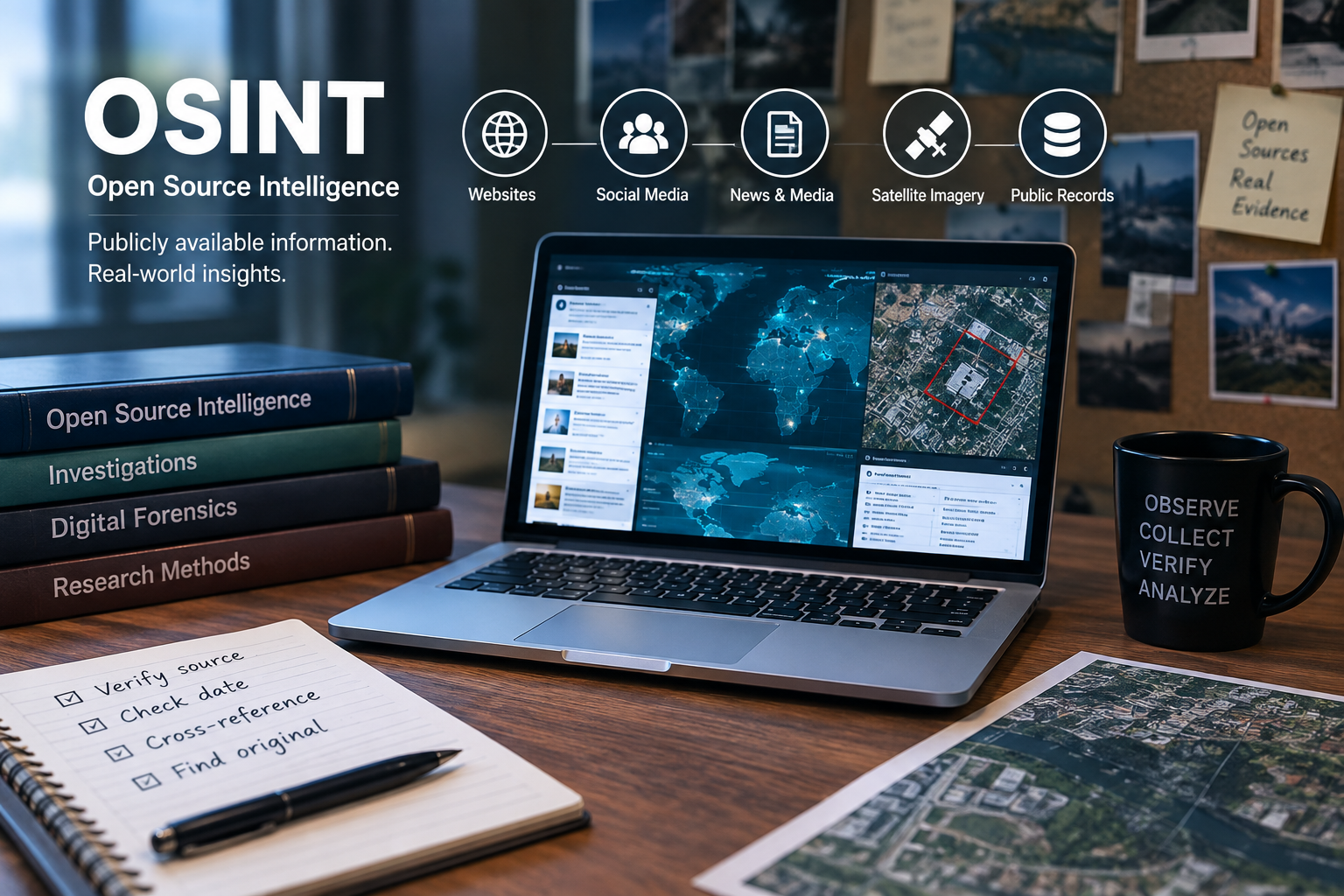
OSINT stands for Open Source Intelligence. It is the process of collecting, evaluating and analyzing information that is publicly or commercially available to answer a defined intelligence question. The U.S. Intelligence Community’s 2024–2026 OSINT strategy describes OSINT as intelligence derived exclusively from publicly or commercially available information that addresses specific intelligence priorities, requirements or gaps.
OSINT is therefore more than searching Google. A useful OSINT investigation starts with a question, collects relevant public sources, checks those sources against each other, analyzes what the evidence actually supports, and records the reasoning so another person can audit the result.
[IMAGE HERE — see Image Block 1 below]
What does OSINT mean?
OSINT means Open Source Intelligence, a discipline for turning publicly available information into a verified, useful assessment. Public sources can include websites, government records, court records, news reports, social media, public databases, corporate filings, images, satellite imagery and other openly accessible material.
The word intelligence is important. A search result by itself is only information. It becomes OSINT when an investigator evaluates its relevance, reliability, context and relationship to a defined question.
The Office of the Director of National Intelligence and Central Intelligence Agency use a similar requirement-based definition in the Intelligence Community OSINT Strategy for 2024–2026.
For Public Evidence readers, a practical definition is:
OSINT is structured research using public information to answer a specific question and support the answer with verifiable evidence.
How is OSINT different from a normal Google search?
OSINT is broader than ordinary web searching because it includes collection, verification, analysis and documentation. A Google search may produce useful sources, but an OSINT workflow asks why a source should be trusted, whether independent evidence supports it, and what conclusions the evidence actually permits.
For example, suppose a social-media post claims that a company was sued.
A normal search might find the post and several websites repeating it.
An OSINT investigation could instead:
- Identify the company precisely.
- Search relevant court systems and government records.
- Locate the case number or official filing.
- Check the filing date and parties.
- Compare the court record with news reports.
- Preserve the source URLs and documents.
- Separate confirmed facts from claims made by the parties.
The second process produces an evidence trail rather than simply a collection of search results.
What information can OSINT use?
OSINT can draw from many types of public or commercially available information, depending on the investigation and applicable law.
Common source categories include:
| Source type | Example use |
|---|---|
| Government records | Verify agencies, filings, licenses or official announcements |
| Court records | Check whether a lawsuit, judgment or filing exists |
| Company records | Research organizations, officers, filings or corporate relationships |
| News archives | Establish when a claim or event was publicly reported |
| Social media | Verify public statements, dates, images and account activity |
| Websites | Compare current and historical claims |
| Web archives | Check what a webpage said at an earlier date |
| Images | Investigate provenance, reuse and visual context |
| Satellite/geospatial imagery | Examine locations and physical changes |
| Public datasets | Check statistics, locations and historical records |
| Academic sources | Verify research claims and scientific context |
| Public metadata | Examine information embedded in files where available |
The Intelligence Community has historically described open-source material as including sources such as newspapers, journals, the Internet, commercial databases, videos, graphics and drawings. The current IC strategy places emphasis on publicly or commercially available information used to address specific intelligence requirements.
How does an OSINT investigation work?
A reliable OSINT investigation follows a repeatable process: define the question, collect sources, preserve evidence, verify, analyze, and report the finding with its limitations.
[IMAGE HERE — see Image Block 2 below]
1. Define the question before searching
Start with a question that can actually be answered.
Weak question:
“Find everything about this company.”
Better question:
“Did Company X receive the government contract announced on June 10, 2026?”
A precise question determines which sources matter and prevents an investigation from becoming an uncontrolled collection of links.
2. Record the starting clues
Write down what you already know.
Depending on the case, that might include:
- Full name
- Organization
- Website or domain
- Username
- Email address
- Date
- Location
- Image
- Document
- Case number
- Quote or claim
- Government agency
- Event
Keep the original wording. A small spelling or date difference can change search results.
3. Search multiple source types
Do not rely on one platform.
For example, a company investigation might use:
- The company’s official website
- Government corporate records
- Court records
- Regulatory filings
- News archives
- Archived versions of webpages
- Public professional profiles
Different sources answer different questions. An official record may establish that something happened, while a news report may provide context.
4. Preserve the evidence
Record the source before it changes.
Useful records include:
- URL
- Page title
- Publication date
- Access date
- Screenshot when appropriate
- Document filename
- Case number
- Archive URL
- Relevant quotation or data point
- Notes explaining why the source matters
For important investigations, keep an evidence log rather than relying on browser history.
5. Corroborate the finding
One public source should rarely be treated as conclusive when the claim is important.
Look for independent confirmation.
For example:
Source A: A social-media account claims a company won a government contract.
Source B: The government’s procurement database lists the award.
Source C: The company’s official announcement confirms the contract.
The three sources do not automatically prove every detail, but they provide substantially stronger support than the social-media post alone.
6. Analyze what the evidence actually proves
Separate:
- Observed fact
- Source’s claim
- Reasonable inference
- Unresolved question
This distinction is one of the most important OSINT habits.
If an official record shows that a person was listed as a company’s director, it does not automatically prove that the person controlled every decision made by the company.
7. Report the finding and its limits
A professional OSINT report should explain:
- What question was investigated
- Which sources were used
- What the evidence establishes
- What remains uncertain
- Which sources conflict
- When the information was checked
- How confident the investigator is
- What should be investigated next
An honest limitation is stronger than an unsupported conclusion.
How can OSINT be used for fact checking?
OSINT can help fact-checkers verify claims by comparing public statements against independent records, historical webpages, official documents, imagery and other sources. The strongest workflow does not ask whether a source “looks convincing”; it asks whether independently verifiable evidence supports the specific claim.
For example, a fact-checker investigating “Agency X announced policy Y on March 4” could search the agency’s official archive, press releases, archived webpages, government documents and contemporaneous reporting.
The key question is not simply “Can I find this claim online?”
It is:
“What primary evidence can independently establish or contradict this claim?”
That distinction makes OSINT particularly useful for Public Evidence’s fact-checking workflow.
Can OSINT verify images and photos?
Yes. OSINT can help investigate an image’s origin, previous appearances, visible landmarks, text, metadata and surrounding context, but no single image-search result automatically proves authenticity.
Google Lens, for example, can search an image or screenshot and return similar images, websites containing the image or related search results.
A basic image-verification workflow is:
- Preserve the original image if possible.
- Run a reverse-image or visual search.
- Search distinctive text, signs and landmarks.
- Check older appearances of the image.
- Compare claimed date and location with available evidence.
- Examine metadata when the original file is available.
- Look for independent photographs or videos of the same event.
- Treat AI-generated or manipulated-image indicators as evidence to investigate, not automatic proof.
[IMAGE HERE — see Image Block 3 below]
Google states that Lens can search using an image, screenshot or camera input and can return similar images and websites containing the image. That makes it useful for provenance research, but visual matching still requires human verification.
What are the most useful OSINT source categories for public-record research?
Government and court records are particularly valuable because they can provide primary evidence for claims about official actions, lawsuits, companies, regulations and public decisions.
For U.S. federal court research, PACER — Public Access to Court Electronic Records — provides electronic access to federal court records. The U.S. Courts explain that users can search cases by court or through the nationwide PACER Case Locator.
PACER currently states that access generally costs $0.10 per page, with a $3 maximum charge for a single document, while users whose quarterly charges are $30 or less have fees waived.
Not every record is available electronically. Sealed documents, for example, are not available to the public through PACER.
This matters for OSINT because absence from a public database does not automatically prove that an event never happened.
The investigator should record what database was checked, what search terms were used, the date of the search and any access limitations.
Which OSINT tools should beginners learn first?
Beginners should learn tools according to the research question rather than collecting dozens of applications. Current OSINT guides commonly separate tools into categories such as search, usernames, domains, infrastructure, archives, images and metadata.
A practical starter stack includes:
| Investigation need | Useful starting resource | What it helps with |
|---|---|---|
| General research | Search engines | Finding public webpages and documents |
| Visual research | Google Lens | Image and visual matching |
| Historical webpages | Internet Archive / Wayback Machine | Comparing older versions of webpages |
| Court research | PACER | U.S. federal cases and filings |
| Relationship mapping | Maltego | Visualizing relationships between entities |
| Domain research | Certificate Transparency/search tools | Discovering public certificate information |
| Metadata | ExifTool | Examining file metadata |
| OSINT resources | OSINT Framework | Finding specialized research tools |
Tool availability, pricing and functionality can change, so tool-specific information should be reviewed periodically.
Why shouldn’t you trust an OSINT tool’s result automatically?
An OSINT tool produces a lead, not necessarily a verified finding. A username match can belong to another person, an image can appear on multiple unrelated websites, and automated systems can misclassify relationships.
A safer rule is:
Use tools to find evidence; use independent sources to verify evidence.
This becomes even more important with AI-assisted OSINT. AI can summarize large amounts of material quickly, but its output should be checked against the original documents before being treated as evidence.
Is OSINT legal?
OSINT is not automatically illegal simply because it involves researching another person or organization, but legality depends on the information, access method, purpose, jurisdiction and applicable laws.
Publicly viewing a webpage is fundamentally different from bypassing authentication, accessing a private account, using stolen credentials or obtaining information through unauthorized access.
In the United States, the Supreme Court’s decision in Van Buren v. United States, No. 19-783, addressed the scope of the Computer Fraud and Abuse Act in the context of authorized computer access. The decision is a useful reminder that the legal analysis depends on the specific access and authorization circumstances rather than the label “OSINT.”
For personal data, the rules can be broader than simple public accessibility. The European Union’s General Data Protection Regulation requires personal-data processing to satisfy applicable principles such as lawfulness, purpose limitation, data minimization and accuracy. Article 6 sets out circumstances under which processing can be lawful.
Therefore, “the information was publicly visible” should not be treated as a universal legal defense.
For professional or high-risk investigations, check the law that applies to the jurisdiction and purpose of the research.
What is the difference between passive and active OSINT?
Passive OSINT generally involves collecting information without directly interacting with the target’s systems, while active techniques interact with systems or infrastructure and may create detectable traffic.
Examples of passive research include:
- Reading public webpages
- Reviewing government records
- Searching public archives
- Examining public social-media posts
- Reviewing published documents
- Searching certificate transparency data
Active security reconnaissance can include direct interaction with a system. That can introduce authorization, terms-of-service, operational-security and legal concerns.
For beginners, passive research is usually the safer starting point.
How reliable is OSINT evidence?
OSINT evidence is only as reliable as the source, collection method, context and corroboration supporting it. A public source is not automatically an accurate source.
A useful source-assessment framework asks:
| Question | What to check |
|---|---|
| Who published it? | Government agency, company, journalist, anonymous account, etc. |
| When was it published? | Original date and later edits |
| Is it primary? | Original record or repetition of another source |
| Can it be independently verified? | Second unrelated source |
| Is the context complete? | Missing paragraphs, edited screenshots, cropped images |
| Could the source be wrong? | Incentives, mistakes, outdated information |
| Can another researcher reproduce the finding? | Search terms, URLs and documented methodology |
The strongest OSINT findings are reproducible. Another researcher should be able to follow the documented trail and inspect the same evidence.
Can OSINT evidence be used in court?
OSINT material can become relevant evidence in legal proceedings, but whether particular material is admissible depends on the jurisdiction, court rules, authentication requirements, hearsay rules, relevance and the circumstances in which the evidence was obtained.
Finding something online is therefore not the same as proving it in court.
For example, a screenshot of a social-media post may show what was publicly displayed, but a legal proceeding may require additional evidence establishing who created the account, whether the screenshot is authentic, when it was captured and whether the material was altered.
Court research should therefore distinguish between:
- Finding a public statement
- Preserving the original material
- Establishing provenance
- Authenticating the evidence
- Establishing what the evidence proves
Do not describe an online discovery as “court-admissible evidence” merely because it was found through OSINT.
What mistakes should beginners avoid in OSINT?
The most common errors are methodological rather than technical.
Relying on one source
One website can repeat an error thousands of times. Repetition does not create independent confirmation.
Treating a username as an identity
A username match is a lead. Look for additional independent identifiers before connecting accounts.
Ignoring dates
A webpage published in 2022 cannot automatically establish what was true in 2026.
Confusing an inference with a fact
If two companies share an address, that may be relevant, but it does not by itself prove ownership or control.
Using screenshots without finding the original
Screenshots can remove dates, URLs and surrounding context.
Trusting AI-generated summaries
AI can help organize research, but the original source should remain the authority for factual claims.
Crossing access controls
OSINT does not mean bypassing authentication or accessing private systems. The method of collection matters.
How can you make an OSINT investigation reproducible?
A reproducible OSINT investigation leaves enough information for another researcher to repeat the important parts of the research.
Keep a simple investigation log containing:
Question: What are you trying to establish?
Starting clues: What information did you have before searching?
Sources: Which URLs, records or documents were examined?
Dates: When were sources published and when did you access them?
Findings: What does each source establish?
Contradictions: Which sources disagree?
Confidence: How strongly does the evidence support the finding?
Limitations: What could not be verified?
Next step: What evidence would strengthen or weaken the conclusion?
This approach turns OSINT from an informal search exercise into an auditable research process.
What should an OSINT report contain?
A useful OSINT report should identify the research question, methodology, evidence, findings and limitations. Readers should be able to distinguish an original source from an investigator’s interpretation.
A simple report structure is:
- Research question
- Executive finding
- Scope and date
- Sources examined
- Evidence
- Analysis
- Contradictory evidence
- Confidence level
- Limitations
- Source list
For fact-checking, add the exact claim being tested and separate the claim from the evidence used to assess it.
What are the best OSINT topics to learn next?
After learning the fundamentals, build separate skills around specific evidence problems rather than trying to memorize hundreds of tools.
Good Public Evidence cluster topics include:
- How to use OSINT for fact checking
- OSINT image verification and reverse image search
- How to verify social-media claims with public records
- OSINT public records research
- How to verify a website using OSINT
- OSINT court-record research
- How to check a company’s digital footprint
- OSINT for journalists and investigative research
- How to verify AI-generated images with OSINT
- OSINT source verification and confidence assessment
These topics can form a broader OSINT and Digital Evidence content cluster around the main Public Evidence pillar.
FAQ: What is OSINT?
What is OSINT?
OSINT, or Open Source Intelligence, is the collection, evaluation and analysis of publicly or commercially available information to answer a defined intelligence question. It can include websites, public records, news, social media, images, government documents, databases and other accessible sources.
Is OSINT legal?
OSINT can be lawful when information is collected through lawful means and used for a lawful purpose, but there is no universal rule that every form of public-data collection is legal. Access controls, privacy laws, data-protection rules, contracts, terms of service and the purpose of processing can affect the legal analysis.
Is OSINT the same as Google searching?
No. Google searching is one technique that can be used during OSINT research. OSINT also involves defining a question, selecting appropriate sources, preserving evidence, corroborating information, analyzing context and documenting the findings.
Can OSINT verify whether an image is real?
OSINT can help verify an image’s provenance and context by using reverse-image search, archives, metadata, visual clues and independent sources. These techniques can reveal reuse or inconsistencies, but no single tool automatically proves that an image is authentic.
Can OSINT information be used as court evidence?
Potentially, but finding information publicly does not automatically make it admissible evidence. Courts can require authentication, relevance and compliance with rules governing evidence. The legal standard depends on the jurisdiction and circumstances.
What is the best way for a beginner to learn OSINT?
Start with a defined research question and learn source verification before learning large numbers of tools. Practice with your own public footprint, public documents, historical webpages and synthetic or authorized research targets, then document every finding so another person can reproduce the investigation.
Editorial freshness note: Review this article every 3–6 months for changes to OSINT tools, platform policies, public-record access, privacy rules and AI-assisted research practices. Legal sections should be reviewed sooner if a major statute, regulation or court decision changes.
Learn what OSINT means, how it works, how to verify information, and how public records and images support evidence-based research.