Last Updated: September 18, 2026
Author: Public Evidence Editorial Team
Reviewed for accuracy: This guide was checked against current guidance and technical material from NIST, Google, and OpenAI.
AI information can be accurate, but you should not treat a confident answer as proof. To check whether AI information is accurate, break the response into specific claims, trace important claims to original or authoritative sources, verify dates and numbers, open and inspect citations, and cross-check high-impact facts independently. NIST and OpenAI both document the possibility of inaccurate or confidently false AI outputs, while Google explicitly tells users to fact-check important information in AI Overviews.
Why can AI give information that sounds right but is wrong?
Generative AI systems can produce fluent answers without having reliable evidence for every statement they make.
OpenAI describes hallucinations as cases where a model confidently generates an answer that isn’t true. Its research also notes that training and evaluation methods can reward guessing rather than acknowledging uncertainty.
NIST uses the term confabulation for generated content that is erroneous or false and presented confidently. Its Generative AI Profile explains that these errors can arise from the way generative models produce outputs based on learned statistical patterns.
That means an AI answer can have:
- correct general information but a wrong date;
- a real source attached to the wrong claim;
- an accurate statistic from an old version of a report;
- a real person’s name paired with an invented quotation;
- a plausible-looking citation that doesn’t support the statement;
- several correct facts surrounding one critical false detail.
The practical lesson is simple: verify the claim, not the writing style.
How accurate are AI models, anyway?
There is no single accuracy percentage that applies to “AI.”
Accuracy depends on the model, task, data, whether it can browse current sources, the wording of the question, and how accuracy is measured.
For example, OpenAI’s SimpleQA benchmark contains 4,326 short fact-seeking questions specifically designed to test factuality. OpenAI reported that GPT-4o scored below 40% on this challenging benchmark when it was introduced.
That does not mean GPT-4o is “40% accurate” in normal use. SimpleQA measures a narrow class of difficult factual questions. OpenAI explicitly warns that benchmark factuality does not automatically tell us how a model performs on long answers containing many different claims.
For users, the more useful question is:
Can I verify this particular claim with evidence appropriate to the claim?
1. Start by separating the AI answer into individual claims
Don’t fact-check a 500-word AI response as if it were one fact.
Break it into statements that can independently be true or false.
For example, imagine an AI response says:
“The law was passed in 2022, applies nationwide, and increased the penalty from $500 to $1,000.”
That’s actually several claims:
| Claim | What to verify |
|---|---|
| The law exists | Official legislation or government record |
| It was passed in 2022 | Legislative record |
| It applies nationwide | Actual statutory language or official guidance |
| The penalty is $1,000 | Current law or official regulation |
| The previous penalty was $500 | Earlier version of the law |
One incorrect detail can change the meaning of the entire answer.
NIST’s current evaluation work similarly focuses on whether factual claims are actually grounded in trusted reference material rather than simply accepting an AI-generated conclusion.
A useful claim-extraction checklist
Look for:
- names;
- dates;
- numbers;
- percentages;
- quotations;
- laws and regulations;
- scientific findings;
- product specifications;
- prices;
- statistics;
- historical events;
- organization names;
- URLs and citations;
- claims about what a study “proved.”
Those are the parts worth checking first.
2. Trace important claims to the original source
The strongest verification usually moves back toward the source of the evidence.
For example:
| AI claim | Preferred verification source |
|---|---|
| Government rule | Government agency or official legislation |
| Court decision | Court record or official legal database |
| Scientific finding | Original research paper |
| Government statistic | Official statistics agency |
| Company feature | Company’s current documentation |
| Product specification | Manufacturer’s official specification |
| Financial figure | Company filing or official financial report |
| Historical document | Archive, library, government record or original document |
| Public statement | Original speech, transcript or recording |
A secondary article can help you find the original evidence, but it should not automatically become the final authority.
NIST’s AI evaluation work specifically emphasizes factual grounding: determining where a claim came from and whether the evidence actually supports it.
For AI and AI-risk claims themselves, useful primary references include the NIST AI Risk Management Framework and its Generative AI Profile.
3. Don’t assume an AI citation proves the claim
A citation is a lead to evidence, not evidence by itself.
Suppose an AI answer says:
“According to a 2025 government report, 73% of users experienced X.”
It gives you a government URL.
That still leaves several questions:
- Does the page exist?
- Is the report actually from 2025?
- Does it contain the 73% figure?
- Does the figure refer to the same population?
- Is the number being quoted in the correct context?
- Is the statistic an estimate, survey result, or measured value?
- Has a newer report replaced it?
Open the source and find the relevant passage.
NIST’s current work on AI evaluation explicitly separates faithfulness—whether the source supports the claim—from completeness and sufficiency, which address whether the output leaves out important context or makes a stronger conclusion than the evidence allows.
The citation test
Ask:
“If I removed the AI answer and read only the cited source, would I reach the same factual conclusion?”
If the answer is no, the citation needs further investigation.
4. Check dates because AI information can become outdated
A fact can be accurate and still be wrong for your question today.
This matters particularly for:
- laws;
- government procedures;
- software features;
- product specifications;
- prices;
- company policies;
- medical guidance;
- security recommendations;
- current events;
- statistics;
- election information.
Check three dates where possible:
Publication date → update date → effective date
Those dates are not necessarily the same.
For example, a government webpage might have been published in 2024 but updated in 2026. A regulation might have been enacted earlier but become effective later.
NIST describes reliability partly in terms of whether an AI system performs correctly under specified conditions over time, while its AI RMF emphasizes ongoing evaluation rather than assuming a system remains reliable indefinitely.
For current information, prefer
- current official documentation;
- current government records;
- current datasets;
- original publications;
- reputable reporting that clearly identifies its sources.
Don’t rely on an AI model’s memory for a fact that changes frequently.
5. Recalculate numbers instead of trusting them
Numbers deserve their own verification step.
AI can make mistakes involving:
- percentages;
- unit conversions;
- averages;
- dates;
- financial totals;
- population figures;
- rates;
- ratios;
- statistical comparisons.
If an AI says:
“A 20% increase followed by a 20% decrease returns you to the original value.”
Check it.
Start with 100:
- 20% increase → 120
- 20% decrease → 96
The result is 96, not 100.
For important quantitative claims, reproduce the calculation yourself or return to the underlying dataset.
OpenAI’s factuality research emphasizes that factuality is difficult to reduce to a single number, while NIST’s AI evaluation work stresses clearly defined evaluation methods and measurement conditions.
6. Compare independent sources when the claim matters
One source can contain an error. Two sources can repeat the same error.
So don’t confuse agreement with proof.
For an important claim, try to find independent evidence.
For example, if an AI says a government agency changed a rule:
- check the agency’s current page;
- find the underlying regulation or announcement;
- check the relevant official document;
- use reputable reporting if the change is controversial or unclear.
Google gives similar advice for AI Overviews: its own guidance says AI responses can contain mistakes and recommends exploring multiple sources when fact-checking important information.
What counts as stronger cross-checking?
Weak:
AI answer → another AI answer → another AI answer
Stronger:
AI answer → official document → independent authoritative source
The second method checks the AI against evidence rather than against another generated answer.
7. Test quotations, names, and citations separately
Fabricated details often hide inside authoritative-looking language.
Be especially careful with:
- quotations;
- academic paper titles;
- DOI numbers;
- court cases;
- statute numbers;
- dates of speeches;
- names of researchers;
- organization names;
- statistics attributed to a specific report.
If an AI gives you a quotation, search the exact wording.
If it cites a research paper, locate the actual paper.
If it gives you a court case, verify the case exists and read the relevant decision.
If it gives you a legal citation, verify the statute, regulation, jurisdiction and current status.
Do not treat a detailed citation as automatically trustworthy simply because it looks scholarly.
OpenAI’s factuality research specifically identifies hallucinations as a continuing problem in language models, including false outputs that can sound convincing.
8. Match the verification effort to the consequences
You don’t need the same level of checking for every AI answer.
A useful risk-based approach is:
| AI information | Verification level |
|---|---|
| Casual definition | Quick source check if important |
| School research | Verify important factual claims |
| Published article | Verify all material claims |
| Business decision | Verify key numbers and assumptions |
| Financial information | Use current authoritative sources |
| Legal information | Check current primary legal sources |
| Medical information | Check authoritative medical sources and qualified professionals |
| Government procedure | Check the current government website |
| Court evidence | Verify the original court record |
| Safety-critical information | Use authoritative guidance and appropriate professional expertise |
NIST’s AI Risk Management Framework treats accuracy, reliability and robustness as context-dependent trustworthiness characteristics rather than assuming one universal threshold works for every use.
The higher the consequences of an error, the stronger your evidence should be.
9. Use AI to help with verification—but don’t make it the final judge
AI can make the checking process faster.
For example, you can give an AI the answer and ask:
“Extract every factual claim from this response. Put each claim in a separate row. For each one, identify what type of primary source should verify it. Do not decide that a claim is true unless evidence is provided.”
That can produce a useful verification checklist.
You can also ask:
“List every date, number, quotation, named person, law, study and citation in this answer that requires external verification.”
Then perform the actual verification yourself.
This distinction matters. The AI can help you find what needs checking, but an AI response should not become the sole evidence that its own previous response was correct.
NIST’s current evaluation research is moving toward precisely this kind of evidence-grounded approach: comparing AI claims against trusted reference documents and evaluating whether the evidence actually supports the output.
What is the fastest way to check an AI answer?
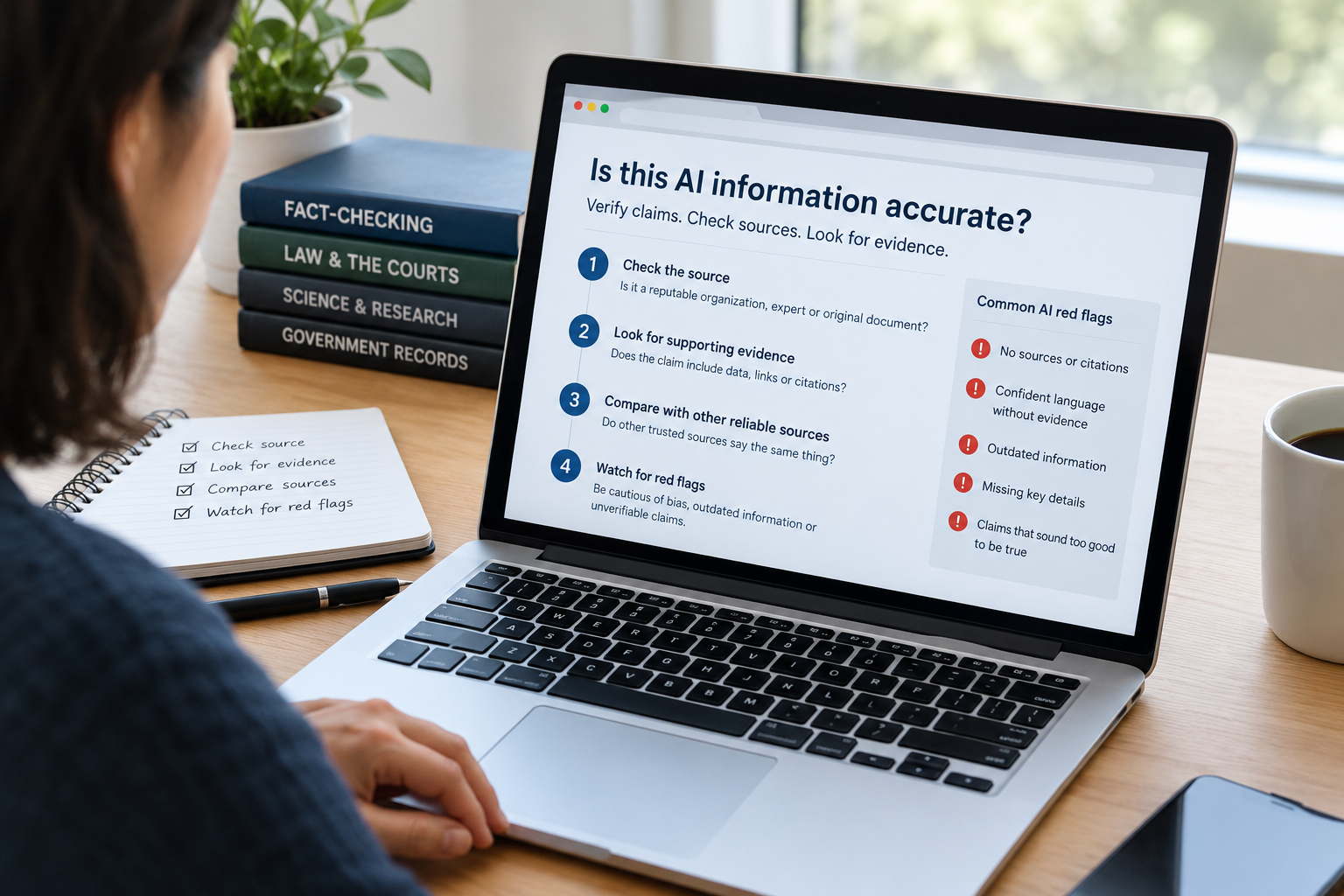
For a normal, low-stakes answer, use this five-minute workflow:
The 5-minute AI accuracy check
1. Find the important claims.
Ignore the filler and identify the facts that actually matter.
2. Circle the risky details.
Focus on dates, numbers, names, quotations, laws and current information.
3. Open the sources.
Don’t rely on the citation title or URL alone.
4. Compare the wording.
Does the source actually support what the AI said?
5. Mark unresolved claims.
If you cannot verify something, don’t silently treat it as fact.
A simple status system works well:
| Status | Meaning |
|---|---|
| Verified | Strong source directly supports the claim |
| Partly verified | Some details are supported, others aren’t |
| Outdated | Previously correct but no longer current |
| Unsupported | No reliable evidence found |
| Contradicted | Reliable evidence conflicts with the AI answer |
This is much safer than deciding an entire AI response is either “good” or “bad.”
How should you check Google AI Overviews?
Google explicitly says AI Overviews can make mistakes and recommends checking important information across multiple sources.
The same basic process applies:
- Read the AI Overview.
- Identify the specific claim you care about.
- Open the cited pages.
- Read the relevant sections yourself.
- Look for the original source behind important claims.
- Compare dates and context.
- Search independently if the claim is important.
An AI Overview appearing at the top of a search page does not eliminate the need for verification.
Google’s own documentation describes AI Overviews as an AI-generated snapshot with links for further exploration, not as a guarantee that every statement is correct.
What sources should you trust most when checking AI information?
There isn’t one universal source hierarchy, but source-to-claim matching is critical.
For example, a government statistic should normally be checked against the relevant government statistical agency. A company’s current feature should be checked against its own current documentation. A scientific claim should be traced to the underlying research where possible.
A practical hierarchy is:
- Original primary evidence
- Official government or institutional records
- Original scientific research
- Official company documentation
- Reputable secondary reporting
- Expert commentary
- Blogs, forums and social posts
Lower-level sources aren’t automatically false. They simply require more scrutiny when they are being used as evidence for an important factual claim.
What should you never use as the only proof?
Avoid these shortcuts:
- “The AI sounded confident.”
- “It gave a citation.”
- “The citation was from a famous organization.”
- “Three chatbots gave the same answer.”
- “Google showed it in an AI Overview.”
- “The answer had lots of detail.”
- “The answer included a percentage.”
- “The source appeared near the top of Google.”
- “The AI said it was 99% confident.”
None of these establishes that a specific claim is true.
OpenAI’s research on calibration found that models can overstate their confidence, while its broader hallucination research emphasizes that confident language does not guarantee factual accuracy.
Can you ever trust AI information without checking it?
Yes, for low-risk uses where an error would have little consequence.
For example, you might use AI to:
- brainstorm ideas;
- explain a familiar concept;
- rewrite your own notes;
- generate examples;
- summarize material you already have;
- create a first draft.
But the standard should change when you plan to publish, cite, spend money, make a legal decision, follow medical guidance, rely on a government procedure, or make another consequential decision.
For those uses, verify the material facts independently.
A simple AI accuracy checklist
Before publishing or acting on an AI-generated answer, ask:
- Did I separate the response into factual claims?
- Did I identify the claims that actually matter?
- Did I check dates and current status?
- Did I verify important numbers?
- Did I open the cited sources?
- Does each source actually support the claim?
- Did I check quotations against the original?
- Did I use a primary source where one exists?
- Did I check important claims against an independent source?
- Did I mark anything I couldn’t verify?
- Is the verification level appropriate for the consequences of being wrong?
If the answer passes this checklist, you have something much stronger than an AI-generated claim: an AI-assisted answer backed by evidence you actually checked.
FAQ: Checking AI Information for Accuracy
Can AI give false information?
Yes. Generative AI systems can produce statements that are false, unsupported or misleading while presenting them in fluent, confident language. OpenAI documents this as hallucination, while NIST discusses related failures under the term confabulation.
How can you tell if AI is giving you accurate information?
Check the specific claims against appropriate original or authoritative sources. Verify dates, numbers, quotations and citations, and use independent sources for important claims.
How do I verify an AI citation?
Open the cited source and locate the evidence yourself. Confirm that the source exists, is current and actually supports the claim the AI attached to it.
Is Google AI Overview always accurate?
No. Google explicitly says AI Overviews can make mistakes and recommends checking important information across multiple sources.
Should I ask another AI if the first AI is correct?
You can use another AI as a second check or research aid, but agreement between two AI systems isn’t proof. For important claims, compare the answers with primary or authoritative evidence.
What information should I fact-check most carefully?
Prioritize claims involving laws, medical information, finances, safety, current events, government procedures, statistics, quotations, dates, numbers and information that could materially affect a decision.
Learn how to check AI information for accuracy using primary sources, citations, dates, numbers, and a practical 9-step verification process.