Last Updated: September 19, 2026
Author: Public Evidence editorial guide — no individual author credentials provided.
Reviewed for accuracy: Checked against current FOIA.gov, U.S. Department of Justice, National Archives, FBI, Census Bureau and FDA guidance.
If you want records from a U.S. federal government agency, you can file a Freedom of Information Act (FOIA) request by submitting a written request that reasonably describes the records you want to the federal agency or component that maintains them. You generally do not need a special form, and you do not have to be a U.S. citizen.
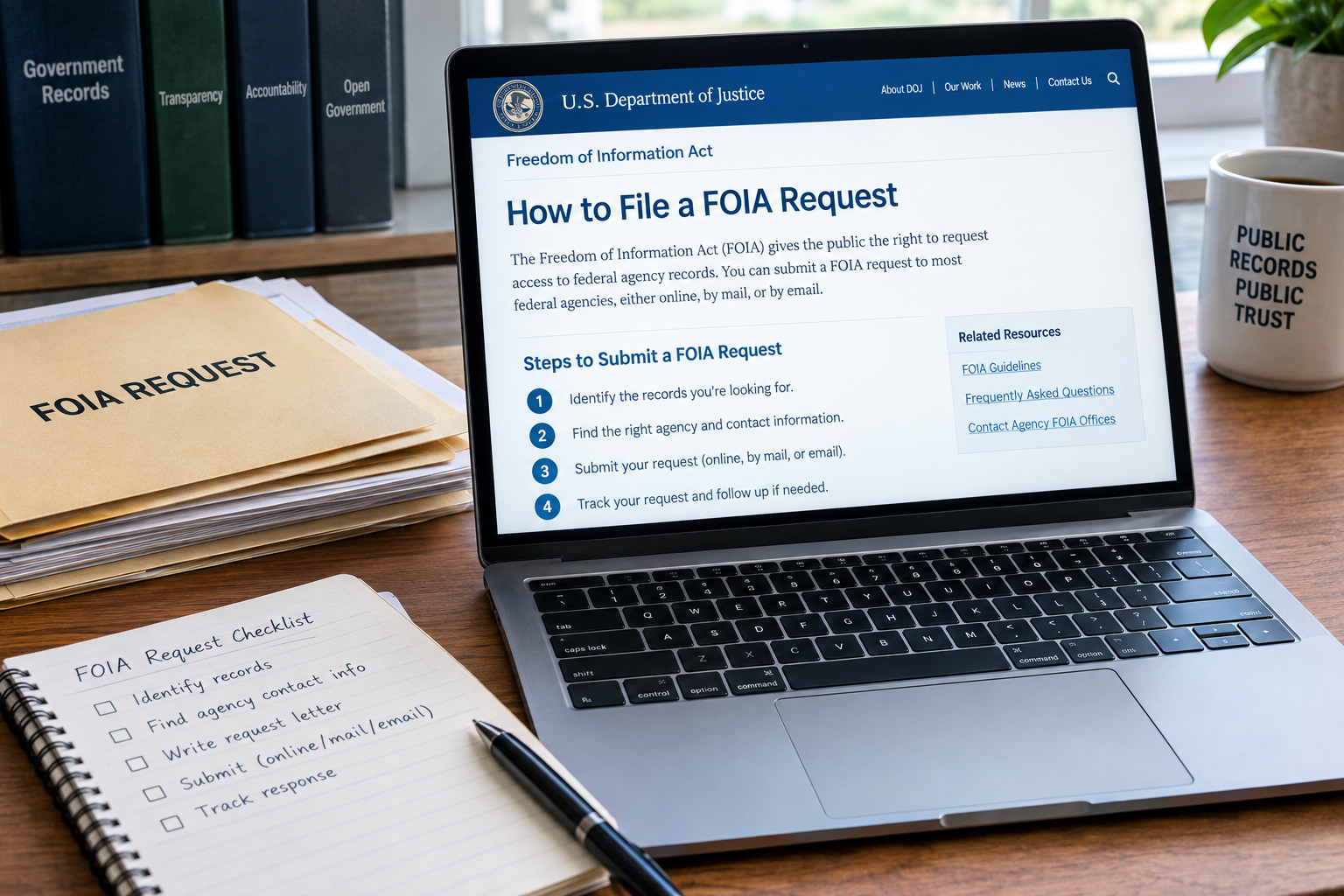
The practical process is: check whether the records are already public, identify the right agency, describe the records precisely, submit the request through the agency’s accepted method, track it, review the response, and appeal if necessary.
What exactly is a FOIA request?
A FOIA request is a formal request for access to records held by a federal agency under the Freedom of Information Act, 5 U.S.C. § 552.
FOIA generally gives any person—including people who are not U.S. citizens—the right to request federal agency records. However, the law contains exemptions and exclusions that can protect certain information, including some material involving national security, personal privacy, law enforcement and privileged government communications.
Read the official FOIA statute — 5 U.S.C. § 552
One important limitation: FOIA is about existing agency records. It does not generally require an agency to answer questions, conduct research for you, analyze information, or create a new record.
For example:
| Better FOIA request | Weaker request |
|---|---|
| “Copies of EPA inspection reports for Company X from January 1 through June 30, 2025” | “Why did the EPA investigate Company X?” |
| “Emails between [official] and [office] concerning [specific project], January–March 2025” | “Give me everything you know about the project.” |
| “FBI records concerning [specific person], including records created between 2018 and 2022” | “Tell me what the FBI knows about this person.” |
The first column asks for identifiable records. The second often asks the agency to perform research or provide an explanation.
Can anyone file a federal FOIA request?
Generally, yes. FOIA.gov states that any person, including someone who is not a U.S. citizen, can make a federal FOIA request.
You do not normally need to explain why you want ordinary agency records.
There are special rules when you request records about yourself. Agencies may require identity verification to prevent someone else from obtaining your private records. DOJ, for example, requires specific identity certification for first-party requests.
Also remember that federal FOIA does not automatically cover records held by:
- State governments
- Counties
- Cities
- Local police departments
- State courts
- Local government agencies
Those records are generally governed by the applicable state or local public-records law.
Before filing, can you find the records without FOIA?
Yes—and you should check first.
Federal agencies are required to proactively publish certain information, and agencies maintain FOIA libraries containing frequently requested records. FOIA.gov also provides a central starting point for finding information that agencies have already released.
Search:
- The agency’s website.
- Its FOIA library or reading room.
- Its public datasets.
- Its frequently requested records.
- FOIA.gov’s agency information.
- The agency’s existing reports, press releases and publications.
This can save weeks or months of waiting.
Search federal agencies and FOIA information on FOIA.gov
Image recommendation — Featured image
Image generation prompt:
Create a realistic editorial-style image showing a U.S. federal records request being prepared at a government records office. Center the composition on a clean desk containing a printed document labeled “Freedom of Information Act Request,” a laptop displaying a generic federal agency FOIA portal, a government records folder, and a pen. Include subtle visual references to public records and document verification without using copyrighted logos. Professional investigative-journalism aesthetic, neutral government-office lighting, natural shadows, documentary photography, sharp readable documents, blue-gray and neutral tones, 16:9 landscape composition, no people looking directly at the camera, no fake government seal.
File name: how-to-file-foia-request-guide-2026.webp
Alt text: FOIA request document being prepared for access to federal government records
Title attribute / caption: A FOIA request asks a federal agency for access to existing government records.
Placement: Directly below the opening answer.
Format/technical note: Export as WebP, ideally compressed and properly sized for the featured-image slot. AVIF can also be used with WebP fallback.
ImageObject schema note: Include the featured image in the page’s ImageObject/Article structured data.
How do you file a FOIA request step by step?
For most federal requests, follow these seven steps.
1. Identify the federal agency that has the records
There is no single federal FOIA office that processes every request. Each federal agency handles its own records, and some large agencies have separate components or offices.
Ask yourself:
- Which agency created the record?
- Which agency received or maintains it?
- Which office is most likely to have it?
- Is the record actually federal?
For example, if you want FBI records, start with the FBI’s FOIA process rather than sending the request to another department.
Find federal agencies and their FOIA contacts
If you’re unsure, read the agency’s FOIA page before submitting. Agencies can have different portals, email addresses, forms and special requirements.
2. Check the agency’s FOIA library first
You may discover that someone already requested the records.
That matters because a FOIA request is unnecessary when the information is already publicly available. FOIA.gov specifically recommends checking existing agency websites and published information before submitting a request.
For frequently requested records, look for terms such as:
- FOIA Library
- FOIA Reading Room
- Electronic Reading Room
- Frequently Requested Records
- FOIA disclosures
- Proactive disclosures
3. Define the records you actually want
This is one of the most important parts of the process.
A vague request can make it difficult for an agency to identify responsive records. Agencies commonly advise requesters to provide details such as:
- Names
- Dates or date ranges
- Subject matter
- Locations
- Document types
- Case numbers
- File numbers
- Names of offices or officials
- Known keywords
- Relevant events
For example, instead of writing:
“I want all records about cybersecurity.”
write something closer to:
“I request copies of reports, memoranda, emails and other records concerning the agency’s cybersecurity incident involving [specific system] between January 1, 2025 and June 30, 2025.”
The FBI and other agencies similarly recommend detailed descriptions that help staff locate responsive records.
Image recommendation — Request-writing visual
Image generation prompt:
Create a professional infographic titled “Write a Specific FOIA Request.” Show a document divided into five labeled fields: Agency, Records Requested, Date Range, Names/Keywords, and Delivery Format. Beside each field, show a simple documentary icon such as a government building, file folder, calendar, person/email symbol, and PDF document. Use clean editorial infographic design, white background, restrained government-records aesthetic, highly legible typography, horizontal 16:9 layout, no stock-photo people, no real agency logos.
File name: foia-request-records-description-guide.webp
Alt text: Infographic showing the details needed to describe records in a FOIA request
Title attribute / caption: Specific dates, names and record types can make a FOIA request easier to process.
Placement: Immediately after the section “How do you file a FOIA request step by step?” and before Step 1, or directly after Step 3.
Format/technical note: WebP, compressed; use responsive dimensions so mobile users don’t download an unnecessarily large file.
ImageObject schema note: Include this image in the Article/ImageObject markup if it is displayed on the page.
4. Write the request
There is no universal federal FOIA form. FOIA.gov says the request generally needs to be in writing and reasonably describe the records sought. Most agencies now offer electronic submission, although the exact method varies.
A practical request should contain:
- Your name and contact information
- A clear statement that you are making a FOIA request
- A precise description of the records
- A date range
- A preferred delivery format
- Your fee category, when relevant
- A fee limit or fee-waiver request if appropriate
You can use this basic structure:
Subject: Freedom of Information Act Request
Dear FOIA Officer:
Under the Freedom of Information Act, 5 U.S.C. § 552, I request copies of the following records:
[Describe the records as specifically as possible, including dates, names, subjects, offices, case numbers or other identifying information.]
Please provide the records electronically where reasonably available.
I am willing to pay up to $[amount] in applicable fees. Please contact me before processing if you expect the fees to exceed that amount.
If any portion of the requested records is exempt from disclosure, please release all reasonably segregable nonexempt portions and identify the exemption supporting each withholding.
Sincerely,
[Name]
[Email]
[Mailing address]
This structure is consistent with sample request language published by federal agencies such as the FBI and Census Bureau.
5. Submit it through the correct channel
Use the submission method specified by the agency.
Depending on the agency, that might be:
- FOIA.gov
- An agency-specific online portal
- Another electronic submission system
Do not assume every agency accepts the same method.
For example, the Census Bureau currently allows electronic submission through FOIA.gov or its Public Access Link and also lists email, fax and mail options.
The FDA, by contrast, directs requesters to its online portal or FOIA.gov and says it is not accepting requests by email or fax.
That difference is why checking the agency’s current instructions before submitting matters.
6. Save the tracking number and correspondence
After receiving a request, an agency will typically acknowledge it and assign a tracking or control number. The agency then searches for responsive records, reviews them, and determines what can be released.
Keep:
- Your original request
- Submission confirmation
- Tracking number
- Agency emails
- Fee estimates
- Clarification requests
- Interim responses
- Final determination
Create a simple folder for each request. If you later appeal, these documents become useful evidence of what you actually asked for and how the agency responded.
7. Review the response and appeal if necessary
An agency may:
- Release all requested records.
- Release some records and redact other portions.
- Determine that no responsive records were located.
- Withhold records under one or more FOIA exemptions.
- Ask you to clarify or narrow the request.
- Provide an estimate of fees.
- Refer or consult with another agency concerning records.
If an agency makes an adverse determination, FOIA provides an administrative appeal process. Agencies must generally give requesters at least 90 days to appeal an adverse determination.
Your agency’s response should explain where and how to appeal.
Read DOJ’s official FOIA appeal guidance
Image recommendation — FOIA process diagram
Image generation prompt:
Design a clean investigative-journalism infographic titled “FOIA Request Process.” Show a left-to-right seven-stage flow: Check Public Records → Find Agency → Define Records → Submit Request → Receive Tracking Number → Agency Searches & Reviews → Release or Appeal. Use document folders, government building, magnifying glass, online submission screen, tracking number, redacted document and appeal letter icons. Minimal professional editorial style, white background, neutral blue-gray accents, crisp typography, 16:9, no logos, no decorative clutter.
File name: foia-request-process-seven-steps.webp
Alt text: Infographic showing seven steps for filing and following a federal FOIA request
Title attribute / caption: The federal FOIA process moves from identifying records to submission, review and possible appeal.
Placement: Immediately after the seven-step section.
Format/technical note: WebP or AVIF with WebP fallback; compress aggressively enough to maintain fast loading while keeping text readable.
ImageObject schema note: Add the image to the page’s Article/ImageObject structured data.
How long does a FOIA request take?
The statutory framework generally gives an agency 20 working days to make a determination on a properly submitted request, excluding Saturdays, Sundays and legal public holidays. The law also provides mechanisms for additional time in certain unusual circumstances.
That does not mean every request will be completed and all records delivered within 20 working days.
A simple request for a small number of readily identifiable records may move faster. Complex requests involving large volumes of records, multiple offices or consultations can take substantially longer. FOIA.gov specifically says processing time varies with complexity and agency backlog.
So don’t treat “20 working days” as a guaranteed delivery date.
Does a FOIA request cost money?
There is no initial fee simply for submitting a FOIA request, but agencies can charge certain fees depending on the requester category and work involved.
Under the statute, fee rules can cover activities such as:
- Searching for records
- Reviewing records in certain circumstances
- Duplicating records
For many noncommercial requesters, the statute provides no charge for the first two hours of search time or first 100 pages of duplication, subject to the statutory fee rules and exceptions.
If cost matters, state a maximum amount you are willing to pay and ask the agency to contact you before exceeding it.
A fee waiver is also possible in qualifying circumstances. The law requires the disclosure to be in the public interest because it is likely to contribute significantly to public understanding of government operations or activities and not be primarily in the commercial interest of the requester.
Don’t simply write “please waive my fees because this is important.” Explain how the requested records would add to public understanding and how you intend to disseminate the information.
What information can FOIA actually get you?
FOIA covers agency records, subject to statutory exemptions and exclusions.
Examples can include:
- Agency correspondence
- Reports
- Memoranda
- Emails
- Certain investigative records
- Policies and administrative records
- Existing datasets
- Existing photographs, videos or other records
- Records concerning particular government activities
The exact availability depends on the agency, the record and applicable exemptions.
FOIA does not require an agency to create a new report just because you ask for one. It also does not normally require an employee to answer a question that is not itself a request for an existing record.
Image recommendation — Redaction visual
Image generation prompt:
Create a realistic close-up editorial photograph of federal government records undergoing FOIA review. Show several pages on a records-review desk, with some lines naturally blacked out as redactions and other paragraphs clearly readable. Include a document folder labeled “FOIA Records” without any real agency seal or confidential-looking personal data. Neutral office lighting, investigative newsroom aesthetic, shallow depth of field, realistic paper texture, 16:9 landscape, no people required.
File name: foia-records-redaction-review.webp
Alt text: Federal records showing FOIA redactions during agency document review
Title attribute / caption: FOIA releases can contain redactions where the law protects specific information.
Placement: After the section “What information can FOIA actually get you?”
Format/technical note: WebP, compressed and responsive.
ImageObject schema note: Include it in ImageObject/Article structured data when displayed.
Why might a federal agency withhold information?
FOIA contains nine exemptions that allow agencies to withhold certain categories of information. Examples include classified national-security information, personal privacy information, certain law-enforcement records and privileged material.
An exemption does not necessarily mean every page must be withheld.
FOIA generally requires agencies to consider whether nonexempt portions can be separated and released.
When records are withheld, the agency should identify the applicable legal basis in its determination.
For evidence-focused research, save the original response letter and the released records together. A redaction can be meaningful evidence about what the agency withheld and which statutory exemption it invoked.
What should you do if your FOIA request is denied?
Start with the agency’s determination letter.
Identify:
- Which records were withheld.
- Whether the denial was complete or partial.
- Which exemption was cited.
- Whether the agency said no responsive records were found.
- Whether you have a right to appeal.
- The deadline and method for filing the appeal.
You can then file an administrative appeal according to the agency’s procedures. Federal law provides at least 90 days to file an administrative appeal after an adverse determination.
You can also seek help from the agency’s FOIA Public Liaison or the Office of Government Information Services (OGIS) at the National Archives. OGIS provides dispute-resolution assistance between FOIA requesters and federal agencies.
Get FOIA dispute-resolution help from OGIS
If administrative remedies do not resolve the dispute, judicial review can be available under FOIA. That is a legal process, so complicated or high-stakes disputes may warrant advice from a qualified attorney.
Is federal FOIA the same as a state public-records request?
No.
This distinction is easy to miss.
Federal FOIA applies to records held by federal executive-branch agencies subject to the statute. A request for a local police report, county email or state-agency record generally needs to be made under the applicable state or local public-records law instead.
For example, a request for records held by the U.S. Department of Justice is handled through the federal FOIA system, while a request for records held by a city police department normally follows that state’s public-records rules.
Before filing, determine who actually owns or maintains the record.
What mistakes make a FOIA request harder to process?
Avoid these common problems:
Asking a question instead of requesting records.
“Why did the agency approve this contract?” is less useful than identifying the records that document the decision.
Using an unlimited subject.
“All records about immigration” could cover an enormous universe of documents.
Choosing the wrong agency.
There is no universal federal FOIA office. Each agency handles its own records.
Ignoring the date range.
A reasonable date range can substantially narrow the search.
Failing to set a fee limit.
If you are concerned about costs, specify how much you authorize and ask to be contacted before fees exceed that amount.
Submitting the same request through multiple channels.
Follow the agency’s instructions. The FDA, for example, specifically tells requesters not to submit the same request more than once through different channels.
Assuming 20 working days means you’ll receive every document in 20 days.
The statutory determination period and the actual production of records are not necessarily the same thing, particularly for complex requests.
A practical FOIA checklist
Before clicking Submit, check each item:
- I confirmed that the records are held by a federal agency.
- I searched the agency’s website and FOIA library first.
- I identified the correct agency or component.
- I described existing records rather than asking questions.
- I included useful names, dates, subjects or file numbers.
- I included a reasonable date range.
- I requested an electronic format where appropriate.
- I explained my requester/fee category if required.
- I set a fee limit or addressed a fee waiver if relevant.
- I used the agency’s current submission method.
- I saved the submission confirmation.
- I saved the tracking number.
- I will keep all agency correspondence.
- I will check the response for exemptions and appeal instructions.
Frequently Asked Questions
How do I file a FOIA request?
Submit a written request to the federal agency or component that maintains the records. Clearly describe the existing records you want, include useful identifying details such as dates and names, and follow that agency’s current submission instructions. There is no universal federal FOIA request form.
Can anyone file a FOIA request?
Generally, yes. FOIA.gov states that any person, including a non-U.S. citizen, can make a federal FOIA request.
How long does a FOIA request take?
The FOIA generally provides an agency with 20 working days to make a determination, but complex requests, unusual circumstances and agency backlogs can make the overall process take much longer.
How much does it cost to file a FOIA request?
There is no initial fee simply to submit a request, but an agency can charge certain search, review or duplication fees depending on the request and requester category. The statute also provides fee rules and exemptions for certain types of requesters.
What happens if my FOIA request is denied?
Read the agency’s determination letter to identify the records withheld and the legal exemption or other reason cited. You can generally file an administrative appeal, and federal law requires agencies to give requesters at least 90 days to appeal an adverse determination.
Can I use FOIA to get state or local government records?
Usually not. Federal FOIA applies to federal agency records. State, county and city records are generally governed by separate state or local public-records laws.
Bottom line
The strongest FOIA requests are specific requests for identifiable existing records sent to the government office most likely to have them. Start by checking whether the information is already public, narrow the request with names and dates, follow the agency’s submission rules, control potential fees, and keep the tracking and response records in case you need to appeal.
For authoritative guidance, use FOIA.gov and the specific federal agency’s FOIA page rather than relying on an old template. Agency procedures can change, and some agencies impose submission requirements that differ from others.
Freshness flag: Recheck this article in 3–6 months, especially the agency-submission links, portal instructions, processing guidance, fee rules and any changes to FOIA regulations or federal agency procedures.
Learn how to file a FOIA request, find the right agency, control fees, track records and appeal a federal FOIA denial.