Learn basement waterproofing costs, methods, causes of basement leaks, and how to choose the right waterproofing solution. Water in a basement is not always caused by the same problem.
Rainwater may be collecting around the foundation. Groundwater may be pushing against the basement walls or floor. A plumbing leak may be mistaken for foundation seepage. In other cases, high humidity creates condensation that looks like a leak.
Basement waterproofing works best when the actual source of the moisture is identified first.
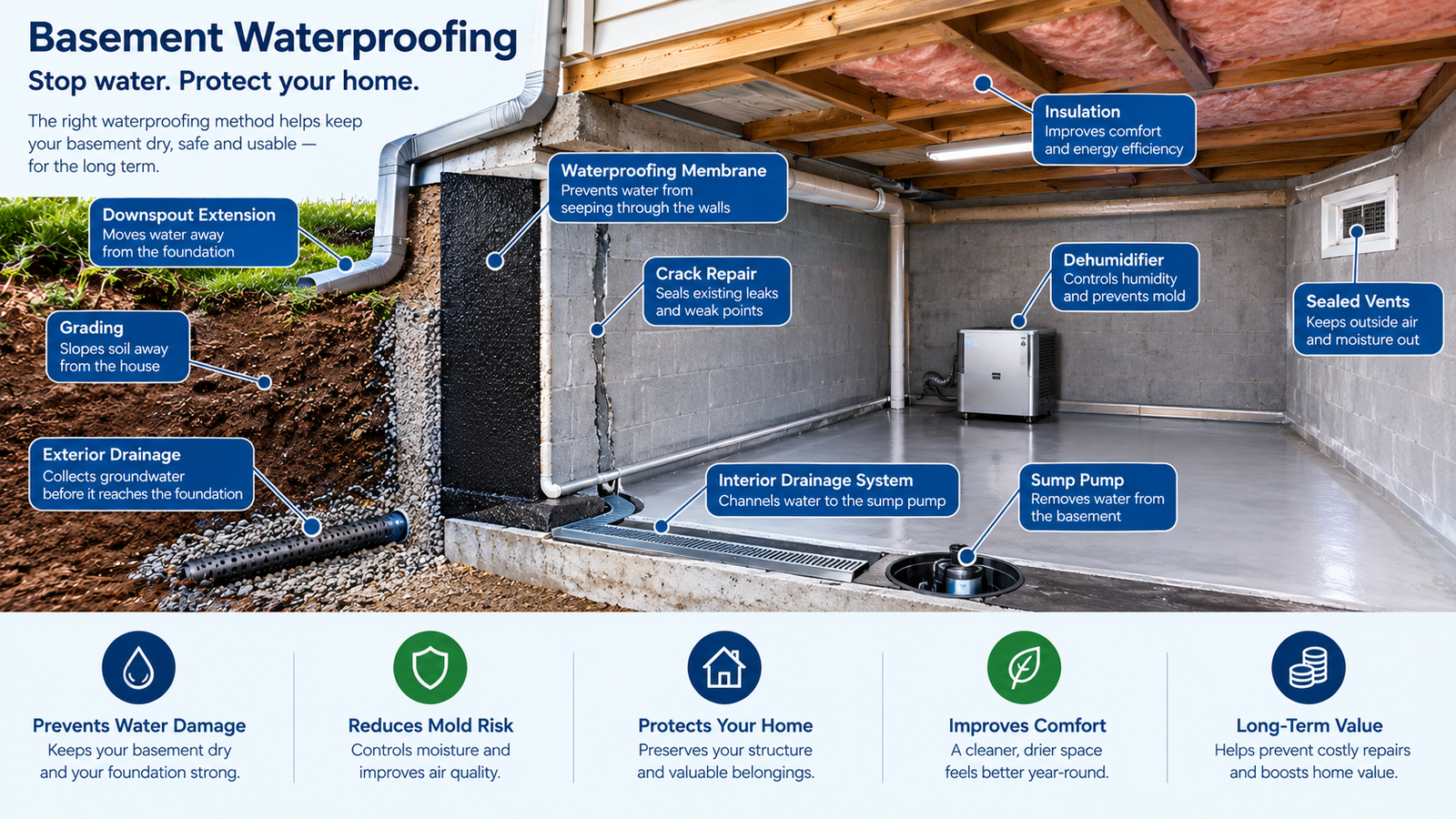
A complete solution may involve grading, gutters and downspouts, crack repair, exterior waterproofing, interior drainage, a sump pump, or a combination of these methods.
Quick Answer
What is basement waterproofing?
It is a group of methods used to control water and moisture around or inside a below-grade foundation.
How much does it cost in 2026?
Current U.S. sources show very different ranges because “waterproofing” can mean anything from a small crack repair to a complete exterior excavation. Angi reports about $2,461–$8,202 for many projects, while Fixr reports approximately $3,000–$10,000. Larger exterior projects can cost substantially more.
What should you do first?
Check gutters, downspouts, grading, foundation cracks, plumbing, and other obvious moisture sources before paying for a major waterproofing system.
Is interior or exterior waterproofing better?
They solve different problems. Exterior work attempts to stop water before it reaches the foundation. Interior drainage systems generally collect water after it reaches the basement and direct it toward a sump or drain.
What Is Basement Waterproofing?
Basement waterproofing is not one product.
It is a collection of moisture-management strategies designed around the way water is entering a building.
Possible solutions include:
- Correcting surface drainage
- Extending downspouts
- Repairing foundation cracks
- Exterior membranes
- Exterior drainage
- Interior perimeter drains
- Sump pumps
- Wall drainage systems
- Vapor or moisture-control materials
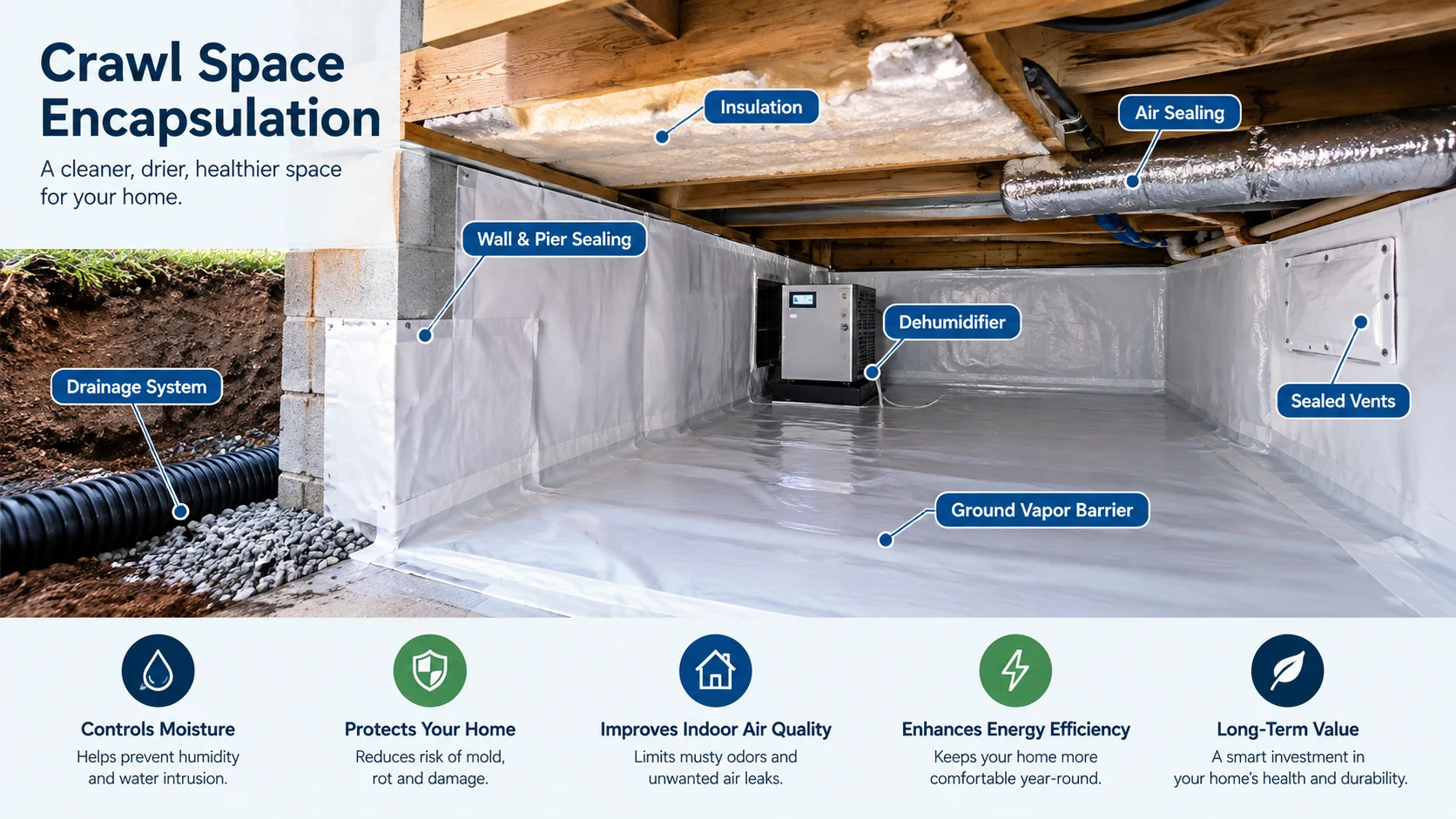
- Dehumidification
- Plumbing repairs
The U.S. Environmental Protection Agency recommends addressing moisture problems before finishing or remodeling a basement because damp conditions can promote biological growth, including mold. EPA also identifies grading and redirecting downspout runoff as possible solutions for some basement moisture problems.
The important point is simple:
Waterproofing should solve the water pathway, not just cover the visible symptom.
What Causes Basement Water Problems?
Before choosing a waterproofing method, determine where the water is coming from.
1. Poor Exterior Drainage
Rainwater can collect beside the foundation when the ground does not direct water away from the house.
This can increase the amount of water reaching the foundation.
Improving grading can sometimes be a much simpler solution than installing a large interior drainage system.
2. Gutters and Downspouts
A roof can collect a large amount of rainwater.
If downspouts discharge directly beside the foundation, that water can contribute to basement moisture.
Possible corrections include:
- Cleaning gutters
- Repairing leaking gutters
- Adding downspout extensions
- Redirecting discharge
- Connecting suitable drainage systems
This Old House similarly recommends moving roof runoff away from the foundation as part of basement moisture control.
3. Foundation Cracks
Water can enter through cracks in concrete or masonry.
But not every crack means the same thing.
A small non-structural crack may require a different repair from a large, widening, or structurally significant crack.
If the crack is accompanied by displacement, significant movement, or structural concerns, it should be evaluated rather than simply painted or sealed.
4. Hydrostatic Pressure
Groundwater can create pressure against foundation walls and floors.
When water pressure becomes significant, moisture may enter through cracks, joints, or other weak points.
An interior drainage system or exterior water-management solution may be appropriate depending on the building and site conditions.
5. High Groundwater
A high water table can create recurring basement water problems even when the surface drainage looks reasonable.
In these situations, drainage and sump-pump systems may become important parts of the solution.
6. Plumbing Leaks
Not every wet basement wall is a foundation problem.
Check for:
- Water heaters
- Supply pipes
- Drain pipes
- Washing machines
- HVAC equipment
- Bathroom plumbing
- Condensate lines
Fixing a plumbing leak is very different from waterproofing a foundation.
7. Condensation
Sometimes the water is actually coming from the air.
Warm, humid air can condense on cooler basement walls, pipes, and floors.
If the moisture appears mainly during humid weather and there is no clear path from outside, humidity control may be more appropriate than extensive drainage work.
Interior vs. Exterior Basement Waterproofing
This is one of the most important decisions.
Exterior Waterproofing
Exterior waterproofing attempts to stop water before it reaches the foundation.
Depending on the property, work may include:
- Excavating around foundation walls
- Cleaning the foundation surface
- Repairing cracks
- Applying a waterproofing or moisture-control membrane
- Installing drainage
- Protecting the membrane
- Backfilling
- Restoring landscaping
Exterior work can be highly disruptive and expensive because excavation is required.
Current cost guides show exterior projects can range from thousands of dollars to well above $10,000 depending on excavation, foundation depth, site access, drainage, and restoration.
Interior Waterproofing
Interior systems generally manage water after it reaches the basement.
A common approach uses:
- Perimeter drainage
- Drainage channels or drain tile
- A sump basin
- Sump pump
- Wall drainage components
Water is collected and directed toward the sump system.
This can be less disruptive than exterior excavation, but it does not necessarily stop groundwater from contacting the exterior foundation.
The Basic Difference
| Exterior approach | Interior approach |
|---|---|
| Works from the outside | Works from inside |
| Attempts to stop water before entry | Collects/manages water after entry |
| Usually requires excavation | Usually requires less exterior disruption |
| Can address exterior foundation conditions | Can provide effective water collection |
| Often more expensive | Often less expensive |
| Landscaping may need restoration | Basement floor/walls may require access |
Neither method is automatically appropriate for every basement.
The correct choice depends on where the water enters and what is causing it.
How Much Does Basement Waterproofing Cost in 2026?
There is no single national price.
Current 2026 sources report substantially different averages because they measure different project scopes.
For example:
- Angi reports $2,461–$8,202 for many projects, with an average around $5,241.
- Fixr reports approximately $3,000–$10,000, with an average around $5,000.
- HomeGuide reports approximately $6,000–$12,000 for interior waterproofing and $10,000–$18,000 for exterior waterproofing.
- This Old House’s current cost guide reports a much higher figure for a specific 1,000-square-foot project, illustrating how project scope and methodology can dramatically change the price.
Why Are Estimates So Different?
Because “basement waterproofing” can mean:
- One crack repair
- A wall coating
- Downspout correction
- Interior drainage
- A sump pump
- Exterior excavation
- Full foundation waterproofing
- Multiple repairs combined
Therefore, do not compare cost estimates without comparing the scope of work.
What Affects the Price?
Basement Size
More wall and floor area generally means more labor and materials.
Waterproofing Method
Interior drainage and exterior excavation have very different labor requirements.
Foundation Type
Concrete, concrete block, stone, and other foundation systems may require different approaches.
Water Severity
A basement with occasional dampness is a different project from one with active groundwater intrusion.
Drainage
French drains, perimeter drainage, sump systems, and exterior drainage can add substantial cost.
Excavation
Exterior waterproofing can become expensive when foundations are deep or difficult to access.
Existing Damage
You may also need to pay for:
- Mold remediation
- Damaged drywall
- Flooring replacement
- Structural repairs
- Insulation replacement
- Electrical work
- Landscaping restoration
Basement Waterproofing Methods
There is no single “best” method independent of the moisture source.
Exterior Membrane
A waterproofing or moisture-control membrane is installed on the exterior foundation wall.
This approach is designed to address water before it reaches the foundation.
Exterior Drainage
Drainage around the foundation can help move groundwater away from the structure.
Interior Perimeter Drain
A drainage channel or drain tile system can collect water entering along the foundation perimeter.
The collected water is directed toward a sump system or suitable discharge point.
Sump Pump
A sump pump removes collected water from the sump basin.
For properties that rely on a sump pump, backup power and pump maintenance deserve attention because the system depends on mechanical operation.
Crack Repair
Targeted crack repair can be appropriate when a specific crack is the water-entry point.
The repair method should match the crack type and the surrounding foundation condition.
Dehumidification
If the problem is humidity rather than bulk water, a dehumidifier may be more appropriate than major drainage work.
What Should You Fix Before Waterproofing?
Start outside.
Check the Gutters
Make sure gutters are not overflowing against the foundation.
Check Downspouts
Downspouts should discharge water where it will not simply collect beside the foundation.
Check Grading
Look at the ground around the home.
Water should generally move away from the foundation rather than toward it.
Check Irrigation
Sprinklers can create unexpected moisture around foundation walls.
Check Plumbing
Rule out indoor plumbing leaks before assuming the foundation is leaking.
EPA’s moisture-control guidance emphasizes controlling water at the site, foundation, walls, plumbing, and other building components rather than treating moisture as a single problem.
Does Basement Waterproofing Prevent Mold?
It can help reduce the moisture conditions that allow mold to grow, but waterproofing is not the same as mold remediation.
EPA advises correcting moisture problems because damp basements can promote biological growth, including mold.
If mold is already present, determine:
- Why the area became wet
- Which materials are affected
- Whether contaminated porous materials need removal
- Whether professional remediation is appropriate
- How the moisture problem will be prevented from returning
Simply painting over visible mold does not solve the underlying moisture problem.
Does Waterproofing Stop All Basement Water?
No.
A waterproofing system can significantly reduce a particular source of water, but no generic product can guarantee that a basement will never become wet under every possible condition.
Extreme rainfall, flooding, plumbing failures, drainage failures, groundwater changes, and equipment failure can create new water problems.
A better goal is:
Identify the water source, control the pathway, and provide a reliable way to manage water that reaches the building.
Basement Waterproofing vs. Damp-Proofing
These terms are sometimes confused.
Damp-proofing is generally intended to resist moisture penetration under less severe conditions.
Waterproofing involves a more comprehensive strategy for resisting or managing water intrusion.
However, homeowners should not rely on the label alone.
Ask what the proposed system actually does.
Does it:
- Resist moisture?
- Stop a specific leak?
- Collect groundwater?
- Pump water outside?
- Drain surface runoff?
- Protect the exterior foundation?
- Control humidity?
The technical system matters more than the name used in the sales proposal.
Signs You May Need Waterproofing
Look for:
- Water stains
- Damp basement walls
- Efflorescence
- Musty odors
- Standing water
- Peeling paint
- Mold growth
- Wet flooring
- Cracks with water staining
- Repeated flooding after storms
- High basement humidity
- Water appearing at the wall-floor joint
A single symptom does not identify the cause.
For example, efflorescence can indicate moisture movement through masonry, while condensation may produce moisture without groundwater entering through the foundation.
When Is Basement Waterproofing Urgent?
Some situations deserve prompt attention.
Standing Water
Standing water can damage materials and create conditions favorable to mold.
Rapidly Increasing Water
A sudden change after heavy rainfall may indicate a drainage or groundwater problem.
Structural Cracks
Large, widening, displaced, or otherwise concerning foundation cracks should be evaluated.
Electrical Hazards
Water near electrical equipment can create a serious safety risk.
Do not enter a flooded area if electrical hazards may be present.
Sewage or Contaminated Water
Sewage backup requires a different response from ordinary groundwater.
Avoid treating contaminated water as a simple waterproofing problem.
What Should a Contractor Quote Include?
Do not accept a proposal that simply says:
“Basement waterproofing — $8,000.”
The scope should be clear.
| Item | What to ask |
|---|---|
| Water source | What caused the problem? |
| Method | Interior, exterior, or both? |
| Drainage | Is drainage included? |
| Sump pump | Included or separate? |
| Discharge | Where will pumped water go? |
| Crack repair | Which cracks are being repaired? |
| Membrane | What product/system is being installed? |
| Excavation | How much excavation is required? |
| Restoration | Is landscaping included? |
| Mold | Included or excluded? |
| Finished walls | Will drywall/flooring be removed? |
| Warranty | What exactly is covered? |
| Maintenance | What maintenance is required? |
| Permits | Who handles applicable permits? |
Basement Waterproofing Red Flags
Be cautious when a contractor:
- Cannot explain where the water is coming from
- Immediately recommends the most expensive system
- Promises a completely dry basement without conditions
- Treats every crack the same way
- Ignores gutters and grading
- Does not explain where a sump pump will discharge
- Gives only a lump-sum price
- Does not specify materials
- Makes broad structural claims without inspection
- Pressures you to sign immediately
A low price is not automatically a good deal.
A high price is not automatically a better solution.
The scope, diagnosis, materials, drainage design, and workmanship matter more than the headline price.
Can You Waterproof a Basement Yourself?
Some minor moisture-control tasks can be DIY projects.
Examples include:
- Cleaning gutters
- Extending downspouts
- Minor surface drainage improvements
- Sealing certain small cracks when appropriate
- Using a dehumidifier
- Monitoring basement humidity
More complicated work may require professionals, particularly:
- Exterior excavation
- Foundation drainage
- Major water intrusion
- Structural cracks
- Sump installation
- Electrical work
- Significant mold contamination
- Foundation movement
This Old House’s current guidance also separates basic crack repairs and drainage improvements from larger exterior waterproofing work.
How Long Does Basement Waterproofing Last?
There is no universal lifespan.
Durability depends on the system and the conditions around the house.
Factors include:
- Material quality
- Installation quality
- Soil conditions
- Groundwater
- Drainage maintenance
- Sump-pump operation
- Foundation movement
- Landscaping changes
- Weather exposure
Exterior membranes, interior drainage systems, sump pumps, sealants, and coatings all have different maintenance requirements.
A waterproofing system should therefore be inspected periodically rather than installed and forgotten.
Does Basement Waterproofing Increase Home Value?
It can make a property more attractive by addressing an existing moisture problem and protecting usable basement space.
However, homeowners should not assume that every dollar spent on waterproofing will return as a dollar-for-dollar increase in selling price.
The effect depends on:
- Local housing conditions
- Severity of the previous problem
- Quality of the repair
- Documentation
- Basement finish
- Buyer expectations
- Overall property condition
The strongest value proposition is usually preventing or correcting a documented water problem, not assuming waterproofing automatically increases the home’s market value.
A Simple Basement Waterproofing Decision Guide
Use the symptom to narrow down the likely solution.
| What you see | What to investigate first |
|---|---|
| Water after heavy rain | Gutters, downspouts, grading, exterior drainage |
| Water at wall-floor joint | Groundwater, hydrostatic pressure, perimeter drainage |
| One leaking crack | Crack type and targeted repair |
| Water around plumbing | Plumbing leak |
| Damp walls without obvious leaks | Humidity, condensation, exterior moisture |
| Repeated sump activation | Groundwater and drainage |
| Water near a window | Window well and exterior drainage |
| Musty smell | Moisture and humidity |
| White powder on masonry | Moisture movement/efflorescence |
| Sudden flooding | Drainage, groundwater, plumbing, or stormwater event |
This is a starting point, not a substitute for an inspection.
Frequently Asked Questions
What is basement waterproofing?
It is a set of methods used to prevent, redirect, collect, or manage water and moisture affecting a basement and its foundation.
How much does basement waterproofing cost in 2026?
Current U.S. cost sources commonly report several thousand dollars for professional work, with many estimates around $3,000–$10,000. Larger or more complex projects, especially exterior excavation, can cost substantially more.
Is interior or exterior waterproofing better?
They address water differently. Exterior waterproofing attempts to stop water before it reaches the foundation, while interior drainage generally collects and manages water after it reaches the basement.
What is the first thing to check?
Check gutters, downspouts, exterior grading, plumbing, foundation cracks, and other obvious water sources before choosing a major waterproofing system.
Does waterproofing prevent mold?
Controlling moisture can reduce conditions that support mold, but existing mold may require separate cleaning or remediation. EPA recommends correcting moisture problems in damp basements.
Does a sump pump waterproof a basement?
A sump pump can remove collected water, but it is only one component of a larger water-management system.
Does waterproofing stop foundation cracks?
It can address water entering through certain cracks, but waterproofing does not automatically repair structural movement or every type of foundation defect.
Is basement waterproofing worth it?
It can be worthwhile when the basement has a recurring water or moisture problem and the proposed system addresses the actual cause. A dry basement without a significant moisture issue may not need an expensive waterproofing system.
Can I waterproof my basement myself?
Some minor drainage and moisture-control improvements can be DIY projects. Major excavation, drainage, structural repairs, electrical work, and significant water intrusion are better evaluated by qualified professionals.
How do I compare waterproofing quotes?
Compare the diagnosis, method, materials, drainage, sump system, discharge plan, repairs, restoration, warranty, and exclusions rather than comparing only the final price.
Sources & Methodology
This guide uses U.S. Environmental Protection Agency guidance on moisture control and basement conditions, current U.S. Department of Energy/building-science principles, and current 2026 home-improvement cost sources.
Cost figures are planning ranges rather than guaranteed prices. Published estimates vary because basement waterproofing can range from a small crack repair to a complete exterior excavation and drainage project. Current 2026 sources demonstrate that difference clearly.
Local soil conditions, climate, foundation type, groundwater, labor rates, accessibility, permits, and project scope can substantially change the final price.
Final Takeaway
Basement waterproofing is not one universal repair.
The right solution depends on where the water is coming from and how it is reaching the basement.
Before spending thousands of dollars, work through the problem in this order:
- Check gutters and downspouts.
- Check exterior grading.
- Rule out plumbing leaks.
- Identify foundation cracks or joints where water enters.
- Determine whether the problem is surface water, groundwater, condensation, or another source.
- Choose interior drainage, exterior waterproofing, targeted repair, or another solution based on that diagnosis.
- Compare contractor quotes by scope rather than price alone.
The most useful question is not:
“Which waterproofing product should I buy?”
It is:
“Where is the water coming from, and which part of this system will stop or manage that water?”