If your crawl space is damp, musty, humid, or showing signs of water damage, crawl space encapsulation may help control the moisture problem.
But encapsulation is more than putting plastic on the dirt floor.
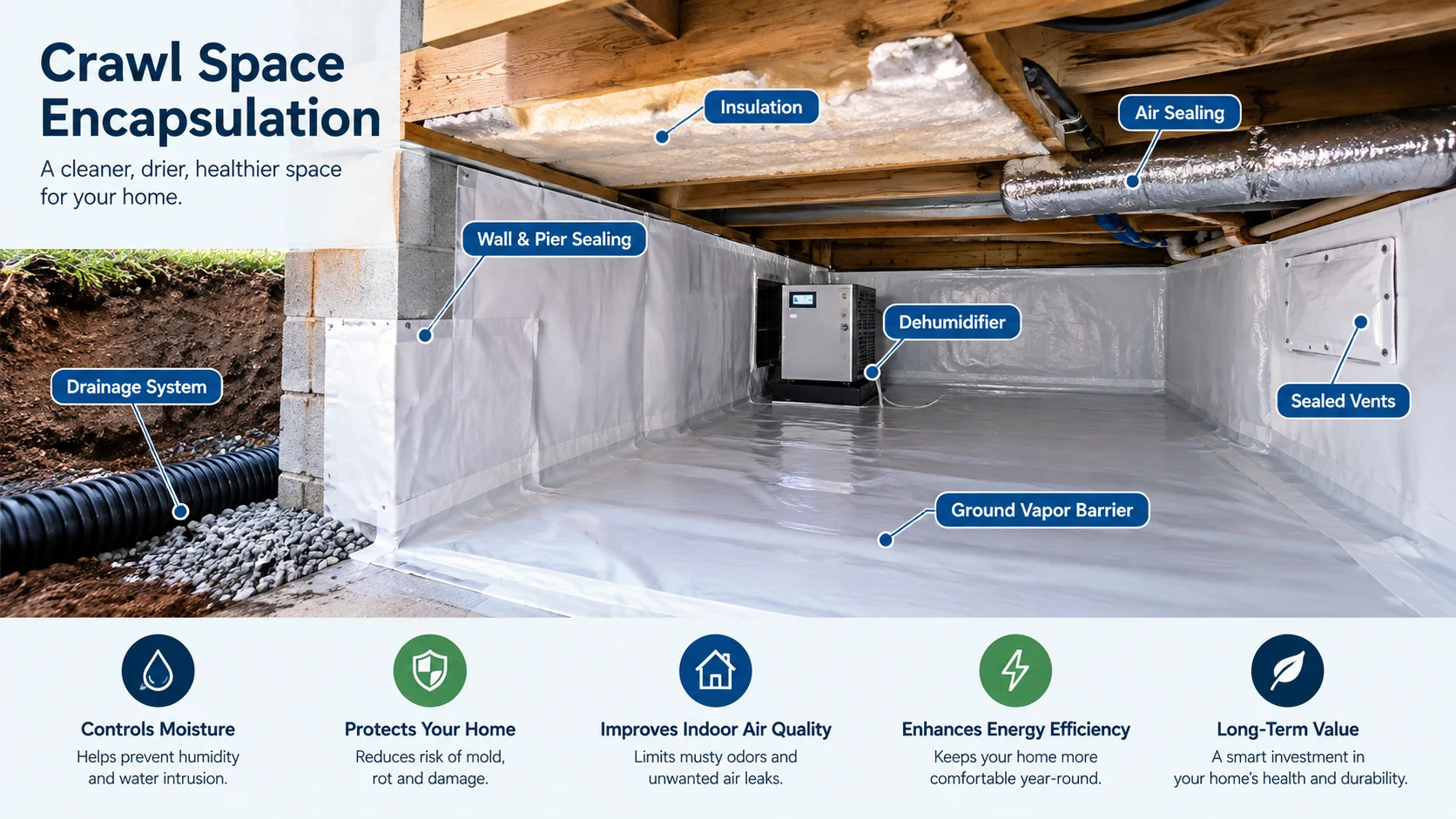
A properly planned system can combine a ground vapor retarder, sealed walls and seams, air sealing, vent treatment, drainage, insulation, and humidity control. The right combination depends on why the crawl space is getting wet in the first place.
Quick Answer
What is crawl space encapsulation?
It is a moisture-control method that separates a crawl space from ground moisture and uncontrolled outside air. A typical system may use a sealed ground vapor retarder, wall coverage, sealed vents, air sealing, and humidity control.
How much does it cost in 2026?
Current U.S. cost guides commonly put professional projects around $5,000–$15,000, although smaller projects can cost less and projects involving drainage, mold cleanup, insulation, or structural repairs can cost substantially more.
Is it the same as installing a vapor barrier?
No. A ground vapor retarder can be one part of an encapsulation system. Full encapsulation may include additional moisture and air-control measures.
Does it stop water?
Not by itself. A ground liner controls moisture coming through the soil, but active water intrusion may require drainage, grading, waterproofing, or a sump system.
What Is Crawl Space Encapsulation?
Encapsulation creates a more controlled environment inside a crawl space.
The basic idea is simple:
Control moisture → control air movement → manage humidity → protect the structure.
A system may include:
- Ground vapor retarder
- Sealed seams
- Wall and pier coverage
- Sealed vents
- Air sealing
- Insulation
- Dehumidification
- Drainage or a sump pump when necessary
The U.S. Department of Energy recommends a minimum 6-mil ground vapor retarder in its crawl-space installation guidance, with the material extending up walls, piers, and columns and seams properly overlapped and sealed.
Crawl Space Encapsulation vs. Vapor Barrier
This is one of the most important distinctions for homeowners.
A vapor retarder primarily limits moisture vapor coming from the ground.
Encapsulation generally describes a broader system that can include the ground covering plus wall sealing, vent treatment, air sealing, drainage, insulation, and humidity control.
| Ground Vapor Retarder | Full Encapsulation |
|---|---|
| Covers exposed soil | Covers the ground and may extend onto walls and piers |
| Controls ground vapor | Addresses multiple moisture and air pathways |
| May be a relatively simple installation | Usually involves several components |
| Does not remove standing water | May include drainage or a sump system |
| Does not automatically control humidity | May include a dehumidifier |
DOE building-science guidance explains that ground moisture can enter a crawl space as both liquid water and water vapor. A continuous ground covering helps control this pathway, while bulk-water problems require additional measures.
How Much Does Crawl Space Encapsulation Cost in 2026?
For U.S. homeowners, current 2026 cost guides commonly report a broad professional range of approximately $5,000 to $15,000. HomeAdvisor currently reports that range with an average around $5,500, while Angi also reports $5,000–$15,000 depending on size and condition.
However, there is no reliable single price for every home.
What Changes the Price?
The biggest factors include:
- Crawl-space size
- Existing moisture
- Standing water
- Drainage requirements
- Vapor-retarder material
- Number of vents
- Wall and pier sealing
- Dehumidification
- Insulation
- Mold or contaminated-material cleanup
- Structural repairs
- Local labor costs
- Access difficulty
For example, This Old House currently lists separate costs for components such as vent covers, insulation, and dehumidification, illustrating why two projects with the same square footage can have very different totals.
A Better Way to Compare Quotes
Do not compare only the final price.
Compare what each contractor is actually including.
A $5,500 quote that covers only the ground may not be equivalent to an $8,500 quote that includes drainage, wall sealing, and humidity control.
What Does Encapsulation Include?
A good system is designed around the home’s actual moisture conditions.
1. Ground Vapor Retarder
The floor is covered with a durable vapor-retarding material to reduce moisture entering from the soil.
DOE guidance specifies a minimum 6-mil ground vapor retarder and recommends extending the material up walls, piers, and columns. It also specifies overlapping seams and securing the material appropriately.
2. Sealed Seams
Small openings can reduce the effectiveness of a continuous moisture-control layer.
The seams, edges, penetrations, and transitions should therefore be handled according to the material and installation system being used.
3. Foundation Wall Coverage
The material may extend up foundation walls and around appropriate supports.
The goal is to create a more continuous moisture-control layer instead of leaving large areas of exposed soil or foundation surfaces.
4. Vent Sealing
Some closed crawl-space designs seal exterior vents.
However, closing vents alone is not encapsulation.
The overall system still needs an appropriate moisture and air-control strategy. Building-science guidance warns that simply closing vents without addressing moisture can create problems.
5. Air Sealing
Moisture can move through air as well as by vapor diffusion.
Air sealing can reduce uncontrolled movement through openings around pipes, ducts, wiring, doors, and other penetrations.
This is why a good system considers both vapor control and air control.
6. Dehumidification
A sealed crawl space can still have high humidity.
Depending on the climate and building design, a crawl-space-rated dehumidifier may be needed.
The dehumidifier handles moisture already present in the air. It does not replace drainage or repair a plumbing leak.
7. Drainage
If liquid water enters the crawl space, a vapor retarder does not make the water disappear.
Depending on the source, solutions can include:
- Exterior grading
- Downspout improvements
- Perimeter drainage
- Interior drainage
- Foundation water management
- Sump pump installation
The correct solution depends on where the water is coming from.
When Should You NOT Encapsulate Yet?
This is an important step that many simplified guides overlook.
Do not treat encapsulation as the first solution when the crawl space has an unresolved water or structural problem.
Investigate the issue first if you find:
- Standing water
- Active plumbing leaks
- Foundation water intrusion
- Severe mold contamination
- Rotting structural wood
- Damaged insulation
- Major pest or termite activity
- Significant drainage problems
- Other unresolved building defects
The principle is simple:
Find the moisture source before sealing the space.
Covering a wet problem without fixing its cause can make diagnosis and future repairs more difficult.
Does Encapsulation Prevent Mold?
It can help reduce the moisture conditions that support mold growth, but it is not a substitute for mold remediation.
EPA guidance emphasizes moisture control as a key part of preventing and controlling mold. Crawl spaces can also contain hidden moisture and mold when humidity remains high.
If mold is already present, ask:
- What caused the moisture?
- Which materials are affected?
- Do contaminated materials need removal?
- How will the moisture source be corrected?
- What cleaning or remediation is included?
A contractor should explain these issues before covering affected areas.
Does Encapsulation Stop Water?
No—not by itself.
This distinction matters.
A ground vapor retarder can reduce moisture vapor coming from soil. It does not automatically stop:
- Groundwater
- Foundation leaks
- Plumbing leaks
- Surface runoff
- Poor grading
- Flooding
DOE guidance separates ground moisture control from bulk-water management for this reason.
If water is entering the crawl space, the water pathway needs to be addressed.
Benefits of Crawl Space Encapsulation
When properly designed for the property, an encapsulated crawl space can provide several potential benefits.
Moisture Control
The ground covering reduces moisture entering from exposed soil.
Lower Humidity
Air sealing and appropriate humidity control can help create a more stable crawl-space environment.
Protection for Wood
Reducing prolonged moisture exposure can help protect structural wood components from moisture-related deterioration.
Better Insulation Performance
When insulation is correctly selected and installed, controlling moisture and air movement can improve the building enclosure.
Fewer Musty Odors
Reducing persistent moisture can help reduce conditions associated with musty crawl-space odors.
More Controlled Environment
A properly designed closed crawl space is easier to monitor and manage than a space with uncontrolled ground moisture and air movement.
These benefits depend on correct design and installation. Encapsulation is not a guarantee of lower energy bills, improved health, or increased property value.
What Are the Downsides?
Encapsulation also has potential disadvantages.
Higher Upfront Cost
A comprehensive system can cost thousands of dollars.
Maintenance
The liner, drainage system, sump pump, and dehumidifier may need periodic inspection or maintenance.
Access Considerations
Plumbing, wiring, HVAC equipment, and other utilities still need safe access after installation.
Existing Problems Still Need Repairs
Encapsulation does not automatically repair structural damage, plumbing leaks, foundation problems, or existing contamination.
Incorrect Installation Can Cause Problems
A poorly designed closed crawl space can remain humid or develop new moisture problems.
The quality of the system matters more than simply having a plastic liner.
How Does the Installation Process Work?
A professional project usually starts with inspection rather than immediately installing the liner.
Step 1: Inspect the Crawl Space
The contractor should look for:
- Water
- Humidity
- Mold
- Damaged wood
- Insulation problems
- Plumbing leaks
- Foundation issues
- Pest activity
- Existing vapor barriers
Step 2: Identify the Moisture Source
Determine whether moisture is coming from:
- Soil
- Groundwater
- Rainwater
- Plumbing
- Condensation
- Humid outdoor air
Step 3: Correct Water Problems
Drainage, grading, plumbing, or foundation issues should be addressed when necessary.
Step 4: Prepare the Space
Debris, damaged materials, and unsuitable insulation may need to be removed.
Step 5: Install the Ground Vapor Retarder
The material is laid across the ground and properly extended, overlapped, sealed, and secured.
Step 6: Seal Walls and Openings
Appropriate walls, piers, vents, access points, and penetrations are addressed according to the system design.
Step 7: Add Humidity Control
If needed, a properly sized dehumidifier and drainage arrangement are installed.
Step 8: Inspect the Finished System
Check for:
- Open seams
- Tears
- Unsealed penetrations
- Loose wall sections
- Drainage problems
- Dehumidifier operation
- Utility access
What Should Be in a Contractor Quote?
A good quote should describe the actual work.
| Item | What to Check |
|---|---|
| Ground liner | Material and thickness |
| Seams | How they will be sealed |
| Walls | Coverage and attachment method |
| Piers | Whether they are included |
| Vents | Whether they will be sealed |
| Air sealing | Which openings are included |
| Drainage | Whether water entry is addressed |
| Dehumidifier | Model, capacity, installation |
| Insulation | Location and material |
| Cleanup | What existing material is removed |
| Mold | Included or excluded |
| Structural repairs | Included or excluded |
| Warranty | What is covered |
| Maintenance | What the homeowner must maintain |
Red Flags
Be cautious if a quote:
- Gives only one lump-sum price
- Does not explain the materials
- Ignores standing water
- Promises to “eliminate mold” without remediation
- Says closing vents is the entire solution
- Guarantees a specific energy-bill reduction
- Does not explain drainage
- Hides exclusions
- Provides no meaningful warranty
The cheapest quote is not automatically the best value.
The most expensive quote is not automatically the best system.
Compare scope first, then compare price.
Can You DIY Crawl Space Encapsulation?
Some homeowners can install a basic ground vapor retarder themselves.
However, a complete project can involve drainage, electrical work, insulation, humidity control, structural concerns, contamination, and local requirements.
DOE installation guidance provides specific requirements for ground vapor-retarder installation, including minimum material thickness, wall/pier extension, seam overlap, and secure attachment.
DIY may make sense for a straightforward dry crawl space with good access.
Professional evaluation is more appropriate when the space has active water, structural damage, significant contamination, or complicated building systems.
Does Encapsulation Require a Dehumidifier?
Not every crawl space requires the same equipment.
The need depends on:
- Climate
- Crawl-space design
- Moisture load
- Air leakage
- Building enclosure
- Existing HVAC conditions
A dehumidifier controls moisture in the air.
It does not replace a vapor retarder or drainage system.
Think of the components this way:
| Problem | Typical control |
|---|---|
| Soil vapor | Ground vapor retarder |
| Bulk water | Drainage/water management |
| Air leakage | Air sealing |
| High humidity | Dehumidification |
| Heat transfer | Appropriate insulation |
How Do You Know If Your Crawl Space Has a Moisture Problem?
Look for:
- Musty smells
- Damp soil
- Standing water
- Condensation
- Wet insulation
- Discolored wood
- Mold-like growth
- Rust or corrosion
- High humidity
- Recurring pest problems
EPA recommends controlling indoor relative humidity below 60%, with an ideal range of about 30%–50%, because excessive humidity can encourage mold growth.
A humidity reading can help identify a problem, but it does not tell you where the moisture originates.
How Long Does Encapsulation Last?
There is no universal lifespan.
Durability depends on:
- Material quality
- Installation quality
- Foot traffic
- Sharp objects
- Rodents
- Water exposure
- Maintenance
- Drainage
Inspect the crawl space periodically for torn material, loose seams, standing water, damaged insulation, and other changes.
Does Encapsulation Increase Home Value?
It may be a useful property improvement, especially when it addresses a documented moisture problem.
However, homeowners should not assume that the entire project cost will automatically be recovered through a higher selling price.
The financial benefit depends on:
- Local housing conditions
- Existing crawl-space problems
- Quality of installation
- Buyer expectations
- Documentation
- Cost of alternative repairs
Current home-improvement sources commonly describe moisture protection, durability, and comfort as potential benefits, but the financial return is property-specific.
Is Crawl Space Encapsulation Worth It?
There is no universal yes-or-no answer.
It makes more sense when a crawl space has a recurring moisture problem that can be addressed through a properly designed moisture-control system.
It may make less sense when the space is already dry, well-controlled, and properly protected.
Before approving a project, ask:
What problem are we solving?
Then ask:
Which component of the proposed system solves that problem?
That approach is more useful than choosing a package simply because it is labeled “encapsulation.”
Crawl Space Encapsulation Checklist
Before signing a contract, confirm:
- Moisture source identified
- Standing water addressed
- Ground vapor retarder specified
- Seams explained
- Wall coverage specified
- Pier treatment specified
- Vent strategy explained
- Air sealing included where needed
- Drainage included where necessary
- Dehumidification evaluated
- Existing damaged materials addressed
- Utility access preserved
- Warranty provided
- Maintenance requirements explained
- Local requirements checked
Frequently Asked Questions
What is crawl space encapsulation?
It is a moisture-control approach that separates a crawl space from ground moisture and uncontrolled outside air. A system may include a ground vapor retarder, wall coverage, sealed vents, air sealing, drainage, insulation, and humidity control.
How much does crawl space encapsulation cost?
Current 2026 U.S. cost guides commonly report approximately $5,000–$15,000, but actual pricing depends heavily on crawl-space size, condition, drainage, insulation, cleanup, and local labor.
Is encapsulation the same as a vapor barrier?
No. A ground vapor retarder can be one component of a broader encapsulation system.
Does encapsulation stop mold?
It can reduce moisture conditions that support mold, but existing mold and its moisture source still need appropriate attention.
Does encapsulation stop flooding?
No. A vapor retarder does not replace drainage or other water-management measures.
Should crawl-space vents be closed?
They may be sealed as part of an appropriately designed closed crawl-space system. Simply closing vents without addressing moisture can create problems.
Do I need a dehumidifier?
Not necessarily. The need depends on the crawl space, climate, moisture load, and overall design.
What thickness should the ground vapor retarder be?
DOE’s current installation job aid specifies a minimum 6-mil ground vapor retarder for the application covered by its guidance.
Can I encapsulate the crawl space myself?
A straightforward ground-cover installation may be suitable for some experienced homeowners. More complicated moisture, drainage, structural, electrical, or contamination problems may require professional work.
How often should an encapsulated crawl space be inspected?
Inspect it periodically for tears, loose seams, water, damaged insulation, equipment problems, and signs of pests. The appropriate maintenance schedule depends on the system.
Sources & Methodology
This guide uses U.S. Department of Energy building-science and installation guidance for crawl-space moisture control, along with U.S. Environmental Protection Agency guidance on moisture and mold. Current 2026 cost information was compared across major home-improvement cost sources.
Cost figures are planning estimates, not guaranteed contractor prices. Local labor, climate, building conditions, drainage requirements, material selection, and applicable requirements can substantially change the final cost.
Final Takeaway
Crawl space encapsulation is not simply a sheet of plastic placed over a dirt floor.
A properly planned system addresses the specific moisture and air-control problems affecting the crawl space.
The most important steps are:
- Find the moisture source.
- Fix active water problems.
- Install an appropriate ground vapor retarder.
- Seal walls, seams, vents, and penetrations where appropriate.
- Add drainage or dehumidification when the conditions require it.
- Compare contractor quotes by scope, not just price.
For homeowners, the best question is not:
“How much does encapsulation cost?”
It is:
“What problem does this system solve, and exactly what am I getting for the price?”