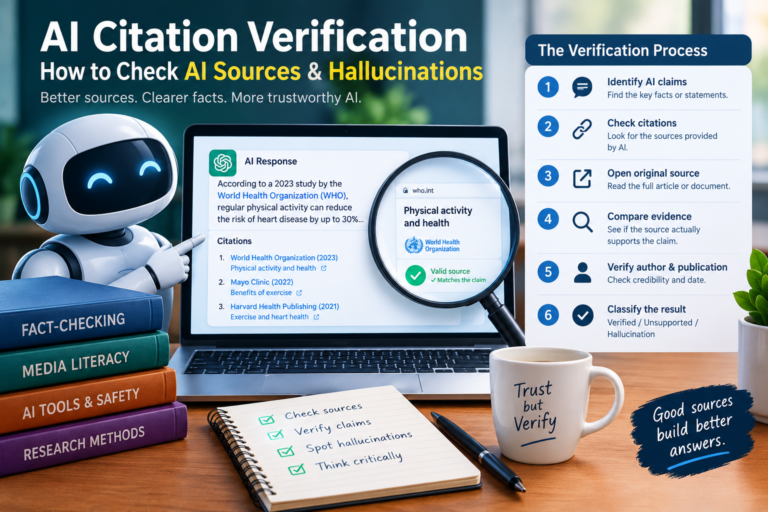
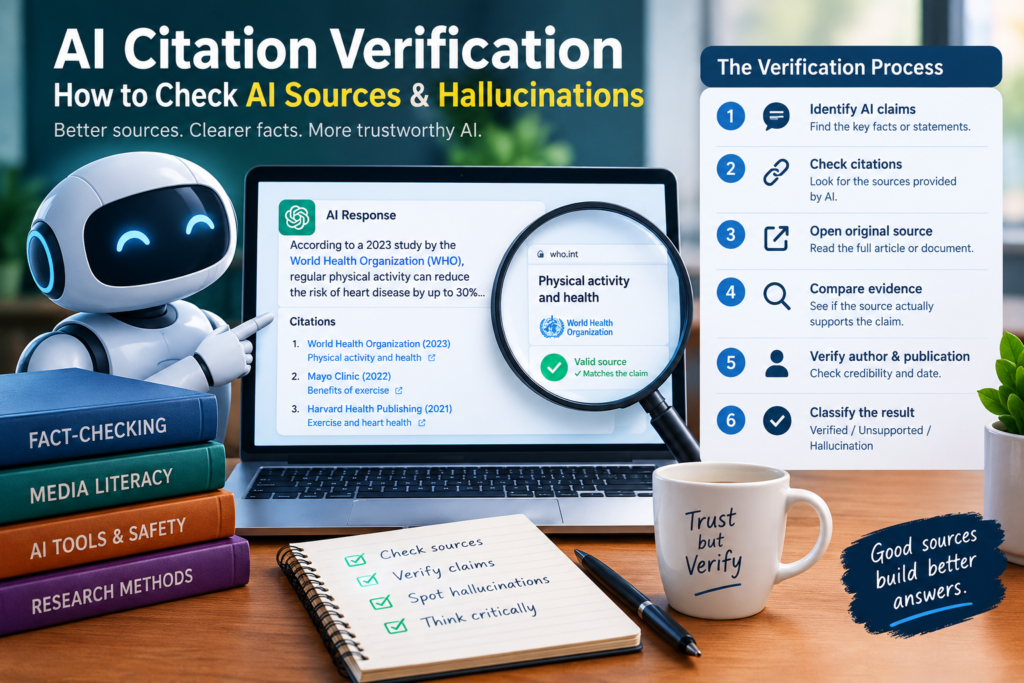
AI citation verification means checking whether an AI-generated source is real, whether its bibliographic details are correct, and—most importantly—whether the source actually supports the claim attached to it. A citation can point to a genuine paper, court case, government page, or report and still be wrong if the source doesn’t say what the AI claims it says.
The safest approach is to treat every AI citation as an unverified lead until you inspect the underlying evidence.
Byline: Public Evidence Editorial Team
Reviewed for accuracy: Sources and factual claims reviewed against primary or authoritative records where available.


5
What exactly is an AI citation hallucination?
An AI citation hallucination happens when an AI system produces a reference that is fabricated, materially incorrect, or attached to a claim that the cited source does not support.
There are several different failure types, and they should not be treated as the same problem:
| Failure | What happened? | Example |
|---|---|---|
| Fabricated source | The cited work doesn’t exist | AI invents a research paper |
| Wrong metadata | A real source exists, but details are wrong | Wrong author, year, journal or DOI |
| Wrong source | A real source is cited for the wrong claim | Paper discusses diabetes but AI cites it for cancer |
| Unsupported inference | Source says something narrower than AI’s statement | Study finds an association; AI says it proves causation |
| Context loss | AI removes an important qualification | “May increase risk” becomes “causes” |
| Stale evidence | Source is real but no longer current | Old government policy presented as current |
| Broken citation | Link, DOI or identifier does not resolve | DOI leads nowhere or to another paper |
This distinction matters because “the citation exists” is only the first verification question.
A 2023 study by William Walters and Esther Wilder tested 636 citations generated in 84 ChatGPT-produced literature reviews. In that dataset, 55% of GPT-3.5 citations and 18% of GPT-4 citations were fabricated. Among citations that were real, 43% from GPT-3.5 and 24% from GPT-4 still contained substantive citation errors.
The results are from older models and should not be treated as the hallucination rate of today’s systems. They do, however, demonstrate why citation verification cannot stop at checking whether a reference looks plausible.
Read the original Scientific Reports study
Why can an AI citation look real but still be wrong?
AI systems can produce fluent, highly plausible references because generating a citation is partly a pattern-completion task. A reference can have the right-looking author names, journal, year and DOI format without corresponding to a real publication.
OpenAI’s guidance on hallucinations explains that language models can produce plausible but false statements, including fabricated citations and references. OpenAI also advises users to verify important information from reliable sources.
There is another, less obvious problem: a real citation can still be a bad citation.
Suppose an AI says:
“A 2024 study proved that X causes Y.”
The cited paper may genuinely exist. But if the paper only found a correlation, used a small sample, studied animals, or explicitly stated that causation could not be established, the citation does not support the AI’s sentence.
That is why Public Evidence recommends verifying the claim-to-source relationship, not merely the reference.
How do you verify an AI citation? Follow these 7 steps
1. Isolate the exact claim first
Don’t begin by searching the bibliography. Begin with the sentence you need to verify.
For each important statement, record:
- The exact AI-generated claim
- The cited source
- The author or organization
- The publication date
- The DOI, URL, case number, report number or other identifier
- Any quotation, statistic or page number
For a long AI answer, break the text into individual factual claims.
This prevents a common mistake: finding a source that is generally related to the topic and assuming it validates everything around the citation.
2. Does the cited source actually exist?
Search for the source independently.
For scholarly material, check the title, authors and DOI against authoritative bibliographic databases. Crossref provides searchable scholarly metadata, including DOI records and publication information. PubMed provides citation records for biomedical literature, while OpenAlex supports searches and identifier lookups across scholarly works.
Useful checks include:
- Exact article title
- Author names
- Journal or publisher
- Publication year
- DOI
- PMID
- ISBN or report number
- Government document number
- Court docket or case number
Crossref metadata search/API documentation
If no independent record can be found, don’t treat the citation as genuine simply because the AI gave you a convincing-looking reference.
3. Do the author, date and identifier match?
A source can exist while the AI gets its metadata wrong.
Compare the AI’s citation against the authoritative record.
Check:
- Author spelling
- Author order
- Article title
- Journal or publisher
- Year
- Volume and issue
- Page range
- DOI
- PMID or other identifier
- Version or edition
This is particularly important for academic research because a citation may combine real pieces from different publications.
A DOI is useful, but don’t blindly trust a DOI copied from AI output. Resolve it and confirm that the resulting record matches the citation.
4. Does the source actually support the AI’s claim?
This is the step most weak citation-checking workflows miss.
Open the original source and find the specific passage, table, figure, paragraph, legal holding, dataset or government record relevant to the claim.
Then ask:
If I removed the AI’s sentence and read only the original source, would I reasonably reach the same conclusion?
Check for differences in:
- Population
- Date
- Geographic area
- Sample size
- Measurement
- Definition
- Legal issue
- Statistical method
- Level of certainty
- Scope of the evidence
For example:
Source: A study reports an association between two variables.
AI claim: “The study proves that one variable causes the other.”
The source exists. The citation is real. The claim is still unsupported.
That is a citation-support failure, not a fabricated-source failure.
5. Is the source authoritative enough for the claim?
Not every true source is equally useful.
Match the source to the question.
| Claim type | Preferred evidence |
|---|---|
| Court ruling | Official court opinion/order |
| Federal regulation | Government agency or Federal Register |
| Government statistic | Official statistical agency |
| Scientific finding | Original paper or authoritative scientific database |
| Medical evidence | Peer-reviewed research, systematic review or authoritative medical source |
| Company policy | Official company documentation |
| Product capability | Official documentation |
| Historical record | Archive, government record or primary source |
| Breaking event | Primary statement plus reputable reporting |
| General background | High-quality secondary source |
For example, if an AI claims that a court imposed a particular sanction, a blog summarizing the case is weaker evidence than the court’s own order.
This is also where source quality and citation correctness separate.
A perfectly accurate citation to a low-quality source can still be the wrong evidence choice for a high-stakes claim.
6. Has the source changed or become outdated?
A citation can be genuine today and still fail to establish that something is true now.
This matters for:
- Government rules
- Regulations
- Court procedures
- Software documentation
- Product features
- Security guidance
- Statistics
- Public policies
- Company information
Record the publication or update date when it matters.
For a time-sensitive claim, ask:
“What was true when this source was published, and is it still true now?”
Don’t use an old source to support a current claim simply because it ranks highly in search results.
Review this article again within 3–6 months: AI citation-verification tools, model behavior, search interfaces and recommended verification databases are changing quickly.
7. Record the verification result
For important research, don’t simply decide “looks good.”
Create a small audit table:
| Claim | Source exists? | Metadata correct? | Supports claim? | Source quality | Status |
|---|---|---|---|---|---|
| Claim A | Yes | Yes | Yes | High | Verified |
| Claim B | Yes | Yes | No | High | Unsupported |
| Claim C | No | — | — | — | Fabricated |
| Claim D | Yes | No | Unclear | Medium | Needs review |
This creates an evidence trail that someone else can reproduce.
For journalism, legal work, research or government-record verification, that trail is often more valuable than a simple “AI checker: passed” label.


Can a real citation still be an AI hallucination?
Yes.
This is one of the most important distinctions in AI citation verification.
Consider four situations:
A. Fake source + fake claim
The paper doesn’t exist and the claim isn’t supported anywhere.
B. Real source + wrong metadata
The paper exists, but the AI gives the wrong author, date or DOI.
C. Real source + wrong claim
The paper exists, but it doesn’t support the statement.
D. Real source + exaggerated interpretation
The source supports a narrow finding, while the AI makes a broader statement.
Only the first case is an obvious fabricated citation. The other three can survive a superficial citation check.
That’s why checking whether a link opens is not enough.
What should you check in legal and court citations?
Legal claims deserve a stricter workflow because a citation error can affect a filing, deadline, argument or decision.
Verify:
- Case name
- Court
- Case/docket number
- Date
- Official opinion or order
- Quoted language
- Pinpoint citation
- Whether the cited passage actually supports the proposition
- Whether the decision is still controlling or has been limited, reversed or superseded
A current example shows why this matters.
On September 9, 2026, the New Mexico Supreme Court issued a direct-contempt order in State v. Sandoval, S-1-SC-40845. The order says attorney Stephen D. Aarons acknowledged using ChatGPT while preparing an appellate brief and admitted that the brief contained fabricated witnesses, false testimony and misrepresented legal authority. The court held him in direct contempt, referred the matter to the Disciplinary Board, struck the briefing, and ordered a $5,000 payment to the State Bar of New Mexico Client Protection Fund.
New Mexico Supreme Court’s case and oral-argument information
The lesson isn’t that AI should never be used for legal drafting. The lesson is much narrower and more practical:
AI-generated legal material must be independently checked against the actual record and controlling authority before it is relied upon or filed.
For Public Evidence’s broader approach to online investigations and source verification, see the existing guide: Scam, Cyber Investigation & OSINT Guide
How should scientific and research citations be checked?
For research claims, start with the original paper whenever possible.
A practical hierarchy is:
Original research → systematic review/meta-analysis → authoritative database → institutional summary → secondary reporting → general web page
The appropriate level depends on the claim. A government agency may be the best source for a current public-health statistic, while the original peer-reviewed paper may be the best source for the underlying experimental finding.
Use independent databases to confirm identity. Crossref’s REST API exposes bibliographic metadata deposited by publishers and other trusted sources, while OpenAlex can resolve works through identifiers such as DOI and PMID.
But database matching is only an identity check.
It doesn’t automatically prove that the paper supports the AI’s interpretation.
Recent research reinforces that distinction. A 2026 paper describing the RefChecker system examined hallucinated references in accepted papers from major AI conferences. Under its strict identity-level definition, the researchers reported that reference-level hallucination rates were generally below 1%, but estimated that roughly one in 20 NeurIPS and USENIX Security papers in 2025 contained at least two likely hallucinated academic-paper-like references.
Those figures should be read carefully: the study used a strict definition of citation hallucination and examined specific conference proceedings, not all scientific publishing.
Read the 2026 Phantom References research


6
Which tools can help verify AI citations?
Tools can speed up the first pass, but they should not become the final authority.
Common verification resources include:
| Tool | Best use |
|---|---|
| Crossref | DOI and scholarly metadata |
| PubMed | Biomedical citations |
| OpenAlex | Scholarly work and identifier lookup |
| Publisher website | Original publication record |
| Government website | Official public records and statistics |
| Court website | Opinions, orders and docket material |
| Library databases | Books, journals and archival material |
There are also newer AI-specific citation checkers. Current tools advertise functions such as DOI matching, author verification, source-quality scoring and citation extraction.
Use these tools as triage systems, not as proof.
A tool saying “verified” generally means that it found a matching record according to its own methodology. It doesn’t necessarily mean that the source supports the exact sentence written by the AI.
That distinction is especially important for legal, medical, scientific and financial claims.
What is the difference between an AI citation checker and an AI hallucination checker?
They overlap, but they aren’t identical.
An AI citation checker usually focuses on references and their metadata:
- Does the citation exist?
- Does the DOI resolve?
- Are the authors correct?
- Does the title match?
- Is the reference complete?
An AI hallucination checker may examine the broader generated answer:
- Are factual claims supported?
- Are sources missing?
- Are citations fabricated?
- Does the evidence support the wording?
- Are multiple claims based on the same weak source?
Neither category should be treated as an infallible truth machine.
The strongest workflow is tool-assisted verification followed by human inspection of the underlying evidence.
What is the fastest reliable workflow for checking an AI answer?
If you don’t have time to verify every sentence equally, prioritize the claims with the greatest consequence.
Check these first:
- Legal claims
- Medical claims
- Financial figures
- Statistics
- Direct quotations
- Named studies
- Government rules
- Dates and deadlines
- Specific allegations
- Claims that could materially affect a person’s decision
For each high-risk claim:
Claim → source → original record → exact supporting passage → context → current status → verification result
That’s usually faster and safer than trying to fact-check an entire AI response word by word.
What should you do when an AI citation cannot be verified?
Don’t silently keep it.
Use one of four outcomes:
Verified: The source exists and directly supports the claim.
Partially supported: The source exists but supports only part of the statement.
Unsupported: The source exists but doesn’t establish the claim.
Unverified/fabricated: The source cannot be independently confirmed or the citation contains material falsehoods.
If a citation fails, remove it or replace it with a source you can independently verify.
Don’t ask the same AI model that produced the citation to simply confirm whether its own citation is real. An independent source database or the original publisher is a stronger verification path.
How should Public Evidence classify AI-generated evidence?
For fact-checking and evidence work, a simple four-level classification works well:
| Classification | Meaning |
|---|---|
| Verified | Primary/authoritative source confirms the claim |
| Supported | Reliable evidence supports the claim, but a primary record isn’t available |
| Unverified | Evidence hasn’t been independently established |
| False/Hallucinated | The source or factual claim is demonstrably fabricated or contradicted |
This prevents an important mistake: treating “not yet verified” as “false.”
A missing citation doesn’t automatically prove that a statement is false. It means the evidence trail is insufficient to establish the claim.
That distinction is central to responsible fact-checking.
Frequently Asked Questions
Can AI generate fake citations?
Yes. AI systems can generate nonexistent papers, incorrect bibliographic details, fabricated quotations and citations that point to real sources but don’t support the stated claim. OpenAI explicitly lists fabricated citations and references among possible hallucination behaviors.
How do I verify an AI citation?
First confirm that the source exists. Then verify its author, title, date and identifier; open the original source; locate the relevant evidence; and determine whether that evidence actually supports the AI-generated claim.
Can a citation be real but still be wrong?
Yes. A real paper can be cited for a claim it doesn’t support. This is one of the most important forms of citation failure because a basic DOI or title check won’t detect it.
What is the best AI hallucination checker?
No single checker should be treated as definitive. Citation databases such as Crossref, PubMed and OpenAlex are useful for verifying source identity, but consequential claims should still be checked against the original source or official record.
Should I trust ChatGPT citations?
Treat them as leads rather than proof. OpenAI itself advises users to critically assess responses and verify important information from reliable sources.
What if the AI citation cannot be found?
Mark it unverified rather than assuming it is true. Search authoritative databases, the publisher’s site, government repositories, court records or other primary sources. If the source still cannot be established, don’t use the citation as evidence.
Bottom line
AI citation verification is not simply checking whether a link works.
A reliable verification process asks six separate questions:
Does the source exist? → Are its details correct? → Is it the right source? → Does it support the exact claim? → Is the context preserved? → Is the evidence current and authoritative enough for the decision?
That standard is stronger than asking an AI whether its own answer is correct. For consequential information, the original document—not the AI’s confidence—is the evidence.
Learn how to verify AI citations, check original sources, and detect fake or unsupported AI claims before trusting them.