Last Updated: September 21, 2026
Author: Public Evidence Editorial Team
Reviewed for accuracy: Sources and factual claims reviewed against Bilibili’s published privacy policy, terms, corporate filings, and current Google Play disclosures.
Short answer: Bilibili is a legitimate video and community platform, and there is no evidence from the sources reviewed that the official Bilibili website or official app is inherently malware. However, calling it simply “safe” misses important privacy and security details. Bilibili’s privacy policy describes collection of account, device, usage, search, location, and other information, while current Google Play disclosures for its official apps show data collection and, for some versions, data sharing with third parties. The safest approach is to use official apps and websites, review permissions, use a unique password, and avoid unofficial APKs.
Is Bilibili a legitimate website?
Yes. Bilibili is an established video-sharing and entertainment platform rather than an anonymous streaming site. Bilibili reported more than 368 million monthly active users in 2025, with about 112 million daily active users, according to its SEC-filed business materials.
That scale does not automatically prove that every privacy or security practice is risk-free. It does, however, distinguish Bilibili from a newly created website with no identifiable operator or published policies.
Bilibili also maintains an official security-response program for researchers and publishes a channel for reporting security vulnerabilities and threat intelligence.
The more useful question, therefore, is not “Is Bilibili a fake website?” It is what information does Bilibili collect, how is that information used, and how should users protect themselves?
What personal information does Bilibili collect?
Bilibili’s current Privacy Policy describes a broad range of information that can be processed depending on which features you use.
The policy lists categories that can include:
- Name and contact information
- Mobile phone number or email address
- Account and user ID information
- IP address
- Device identifiers and device information
- Browser and operating-system information
- Search terms and browsing history
- Viewing, liking, sharing, commenting, and interaction records
- Cookies and similar technologies
- Approximate or precise location information in applicable situations
- Payment and transaction-related information
- Photos, videos, microphone, camera, calendar, or storage permissions when specific functions require them
That does not mean Bilibili necessarily collects every listed category from every user. Its policy says the information actually collected varies according to the service and functions a person uses.
For example, searching on Bilibili can involve collection of search terms, device information, browsing history, and search activity. Video playback can involve device and network information. Camera and microphone access is associated with functions such as recording, uploading, and livestreaming.
This distinction matters. A privacy policy can describe information that a service may collect in different scenarios without meaning that every user has every type of data collected.
Does Bilibili share your personal information?
Bilibili’s privacy policy says information may be provided to affiliated companies or third parties in certain circumstances, including to provide services and support platform functions.
The policy also describes third-party software development kits, or SDKs. These can support functions such as push notifications, payments, analytics, crash reporting, or social sharing.
For users, this creates an important distinction:
Bilibili itself is not necessarily the only party involved in processing information when you use a feature.
The privacy policy specifically advises users to review the privacy terms of relevant third-party SDK providers where applicable.
Google Play provides another useful view because its Data Safety section is specific to the app listing. For the current official Bilibili international app listing, Google Play says the app may share personal information with third parties, may collect personal and financial information and app activity, encrypts data in transit, and provides a way to request data deletion.
Google also warns that data-safety information can vary according to app version, use, region, and age. That means users should check the listing for the exact Bilibili app they install.
Is the Bilibili app safe to install?
The safest option is to install Bilibili through an official app store or an official Bilibili distribution channel.
Current Google Play listings for official Bilibili apps provide security and data-safety information. For example, the BiliBili HD Anime, Videos listing currently reports encryption in transit and an option to request data deletion.
Do not assume that an APK called “Bilibili” is official simply because it uses the Bilibili name or logo.
Before installing an APK, check:
- Who published the app.
- Whether it is linked from an official Bilibili property.
- Whether the package name matches the legitimate app.
- What permissions the app requests.
- Whether the download came from a reputable app store.
- Whether the app has been modified or repackaged.
Bilibili’s own international terms specifically restrict use through unauthorized methods and warn users about risks associated with downloads and data obtained through its services.
What about unofficial Bilibili APKs?
This is where the risk changes significantly.
An unofficial APK can be modified by someone other than Bilibili. That means the security characteristics of the original application cannot automatically be applied to the modified file.
A common mistake is to search for an APK because the official app is unavailable in a particular country, then install the first download found on a third-party website. That creates a separate security question from whether Bilibili itself is legitimate.
For sensitive accounts, avoid modified APKs unless you have a strong reason and can independently verify the software’s provenance.
Is Bilibili safe for privacy?
Bilibili is usable from a privacy perspective, but privacy-conscious users should understand that the platform collects substantial information to operate and personalize its services.
Its policy says Bilibili can process information such as search history, browsing activity, viewing behavior, interactions, device information, and location information for functions including personalized recommendations.
The policy also describes controls for some personalized recommendations and advertising preferences.
Users should therefore think about Bilibili privacy in terms of data minimization, not simply whether the platform is “safe.”
If you don’t need a permission, don’t grant it.
If a feature requires location, camera, microphone, photos, or another sensitive permission, ask whether you actually need that feature.
Can Bilibili access your location?
Bilibili’s privacy policy says location information can be collected for certain functions, including personalized recommendations and location-based features.
The policy distinguishes between approximate and precise location information. It also describes situations where users can enable or disable location permissions through their device or relevant Bilibili settings.
That means location access is not something users should treat as an automatic requirement for watching every video.
If you only want to watch videos and don’t need location-based features, review the location permission on your device and disable it if appropriate.
Does Bilibili collect your search history?
Yes. Bilibili’s privacy policy specifically states that its search function can involve collecting the words or phrases you search, along with information such as browsing history, search times, and search frequency.
The company says this information is used to match users with relevant content and improve its products and services.
Bilibili also says it can use search records, browsing records, favorites, viewing duration, interactions, and other behavioral information to understand user preferences and provide personalized recommendations.
For privacy-conscious users, this is one of the most relevant parts of the policy because your viewing behavior can reveal interests even when you never explicitly publish them.
Is Bilibili safe for children?
Parents should treat Bilibili as a user-generated-content platform rather than assuming every video is suitable for children.
Bilibili’s international terms say children under 13 are not allowed to independently register accounts, while minors in other jurisdictions may require parental or guardian involvement depending on local rules.
The platform’s privacy policy also contains a section specifically addressing minors and says it applies protections required by applicable laws.
That does not mean every piece of content is appropriate for every child.
Parents should still consider:
- The child’s age
- Content ratings and restrictions
- Public comments and user interactions
- Private messages or contact from other users
- Advertising and recommendations
- Whether the child is uploading personal information
- Whether the child is using an official application
For younger users, parental supervision remains important even when platform-level protections exist.
Is Bilibili safe outside China?
Bilibili operates services for users outside mainland China, and its international terms identify Balaboom Pte. Ltd. as the relevant service provider for those terms.
The international terms also state that they are governed by Singapore law and provide for arbitration through the Singapore International Arbitration Centre.
Privacy treatment can still depend on the particular service, region, app, and account.
This is why an international user should check the privacy policy and app-store listing associated with the exact Bilibili service being used rather than relying on information about a different Bilibili application.
Does Bilibili encrypt your data?
For the current official BiliBili HD Anime, Videos Google Play listing, Google reports that data is encrypted in transit.
That is a useful security control, but it does not mean every privacy risk disappears.
Encryption in transit protects data while it travels between the app and servers. It does not prevent a service from collecting information that its privacy policy permits, and it does not protect an account from a weak password, phishing attack, malicious APK, or compromised device.
Bilibili’s own international terms also state that it cannot guarantee that third parties will never intercept data transmitted over the internet.
So “encrypted” should not be interpreted as “nothing can ever go wrong.”
Can you delete your Bilibili data?
Bilibili’s privacy policy provides users with rights to manage personal information, including correcting information and withdrawing authorization for certain processing.
The policy also states that users can terminate authorization by closing their account, although previous processing based on authorization is not necessarily erased simply because a permission is later disabled.
Google Play’s current data-safety information for official Bilibili apps also indicates that users can request deletion of data.
Before closing an account, save anything you legitimately need to keep. Account closure can affect access to content, purchases, history, and other account-linked information.
What are the biggest Bilibili safety risks?
The evidence points to several different risk categories rather than one single “Bilibili risk.”
| Risk | What the evidence shows | Practical response |
|---|---|---|
| Privacy collection | Bilibili’s policy describes collection of account, device, usage, search and other data | Review permissions and privacy settings |
| Third-party processing | The policy describes third-party SDKs and service providers | Review relevant third-party privacy terms |
| Unofficial APKs | Bilibili’s terms distinguish official from unauthorized methods | Install from official sources |
| Account theft | Bilibili’s international terms tell users to protect account credentials | Use a unique, strong password |
| User-generated content | Bilibili warns that public content can expose information about users | Avoid posting sensitive personal information |
| Phishing/scams | Like other large platforms, users can encounter suspicious links or messages | Don’t click unfamiliar links or install unknown software |
| Child safety | Bilibili has minor-related provisions, but content is user-generated | Use age-appropriate supervision |
This table is more useful than a blanket “safe” or “unsafe” label because each risk requires a different response.
How can you use Bilibili more safely?
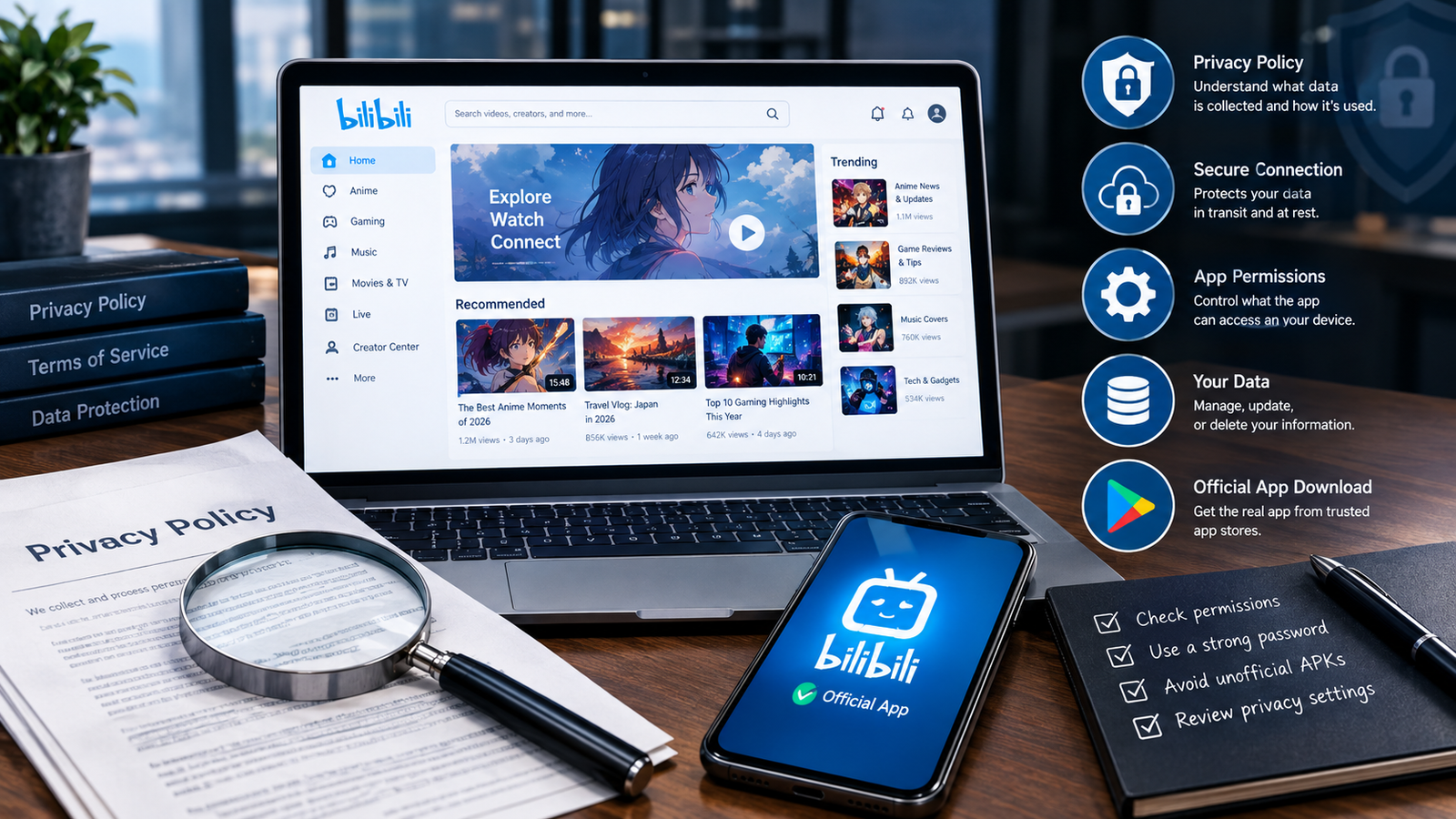
Use this checklist before creating an account or installing the app:
- Use the official website or app store listing. Avoid modified APKs and unknown download sites.
- Use a unique password. Never reuse your main email or banking password.
- Review app permissions. Check location, camera, microphone, photos, contacts, and storage access.
- Limit unnecessary personal information. Don’t put your phone number, address, school, workplace, or other sensitive details in public profiles or comments.
- Be careful with links in comments and messages. A legitimate Bilibili account does not make every user-provided link legitimate.
- Review personalized-ad and recommendation settings. Use the controls provided by Bilibili and your device.
- Keep the app updated. Security fixes are often delivered through application updates.
- Don’t install a “special player” from a random website. If a video tells you to download an unknown APK or executable, stop and verify it first.
- Check the app publisher. Multiple unrelated apps using the Bilibili name can appear in app stores.
- Recheck the privacy policy periodically. Bilibili says its privacy policy can be updated as laws, products, or business practices change.
What does the evidence say about Bilibili’s security?
There are several positive security signals, but they should be interpreted carefully.
Bilibili maintains an official security-response center for vulnerability and threat-intelligence reports. Its corporate disclosures also describe privacy and security controls, including encryption and anonymization measures.
At the same time, Bilibili’s own terms do not promise perfect security. Its international terms explicitly say the company cannot guarantee the security of information transmitted over the internet and places responsibility on users for protecting their account credentials.
That combination is typical of how a mature online service should be evaluated: look at the controls that actually exist rather than treating either the company’s claims or third-party ratings as absolute proof of safety.
So, is Bilibili safe to use in 2026?
For ordinary use, the evidence supports treating the official Bilibili service as a legitimate platform that can be used with normal online-security precautions. But it should not be treated as a zero-risk privacy environment.
The biggest practical distinctions are:
- Official Bilibili website/app: legitimate service with published privacy and security documentation.
- Privacy: Bilibili collects a meaningful amount of account, device, usage, and behavioral information depending on the features you use.
- App security: current official Google Play listings report encryption in transit and provide data-safety disclosures.
- Unofficial APKs: a separate and avoidable risk; don’t assume they have the same security properties as the official application.
- Children: use age-appropriate supervision because Bilibili contains user-generated content.
- Privacy-conscious users: review permissions, personalization settings, and the information placed on the account.
The most accurate answer is therefore not simply “yes” or “no.” Bilibili is a legitimate service, but safe use depends on which Bilibili app or website you use, what permissions you grant, what information you share, and whether you avoid unofficial software.
Review this article again in 3–6 months
Bilibili’s privacy policy, app listings, security practices, and regional services can change. This article should be reviewed again by March–June 2027, especially the Google Play Data Safety information and Bilibili Privacy Policy.
Frequently Asked Questions
Is Bilibili safe to use?
Bilibili is a legitimate video platform, but it is not risk-free. Its privacy policy describes substantial data processing, so users should review permissions, protect their accounts, and use official apps and websites.
Is the Bilibili app safe to download?
The safest option is to download an official Bilibili app from an authorized app store or official Bilibili source. Avoid modified or unknown APK files because their security cannot be assumed from the official app’s reputation.
Does Bilibili collect personal information?
Yes. Bilibili’s privacy policy describes collection of information such as account details, device information, search activity, browsing and viewing behavior, interactions, and location information for certain functions.
Does Bilibili share your data?
Bilibili’s privacy policy says personal information can be provided to affiliated companies and third parties in certain circumstances. It also describes third-party SDKs used for functions such as analytics, payments, notifications, and crash reporting.
Is Bilibili safe for children?
Bilibili has provisions for minors, but it is also a user-generated-content platform. Parents should consider age suitability, public interactions, messages, personal-information exposure, and the child’s ability to recognize unsafe content or links.
Can you delete your Bilibili data?
Bilibili’s privacy policy provides mechanisms for managing personal information, and current Google Play disclosures for official Bilibili apps indicate that users can request data deletion. The exact process can depend on the service and account.
Future Public Evidence Cluster
This article can serve as the pillar page for a Bilibili privacy and safety cluster.
Recommended follow-up articles:
- Bilibili Privacy Policy Explained: What Data Does Bilibili Collect?
- How to Delete Your Bilibili Account and Personal Data
- Is Bilibili APK Safe? How to Check an APK Before Installing It
- Bilibili Data Collection: What Your Search and Viewing History Reveals
- How to Check If a Bilibili Link Is Legit or a Scam
Is Bilibili safe? See what its privacy policy, app data disclosures, and security practices reveal before you use the platform.