






If you’ve ever typed a name into Google and wondered “is that really all there is?” — the answer is almost always no. Somewhere between the first page of search results and the deep corners of the internet sits an entire discipline built around one simple idea: almost everything you need is already public. You just don’t know where to look.
That discipline is called OSINT — Open Source Intelligence — and it’s quietly become one of the most in-demand skills of the decade. Journalists use it to expose corruption. Recruiters use it to vet candidates. Cybersecurity teams use it to find weaknesses before hackers do. Private investigators use it to locate missing persons. And increasingly, ordinary people are learning it just to protect themselves — because if you can find someone’s information this easily, so can a stranger with bad intentions.
This article isn’t going to give you the same recycled “use Google dorks” advice you’ve read on twenty other sites. We’re going deeper — into the actual workflow professionals use, the tools nobody talks about, and the mistakes that get investigations (and reputations) ruined.
What OSINT Actually Means
OSINT stands for Open Source Intelligence — the practice of collecting and analyzing publicly available information to build a picture of a person, company, or event. “Open source” here doesn’t mean software; it means information that’s legally accessible without hacking, bribing, or breaking into anything.
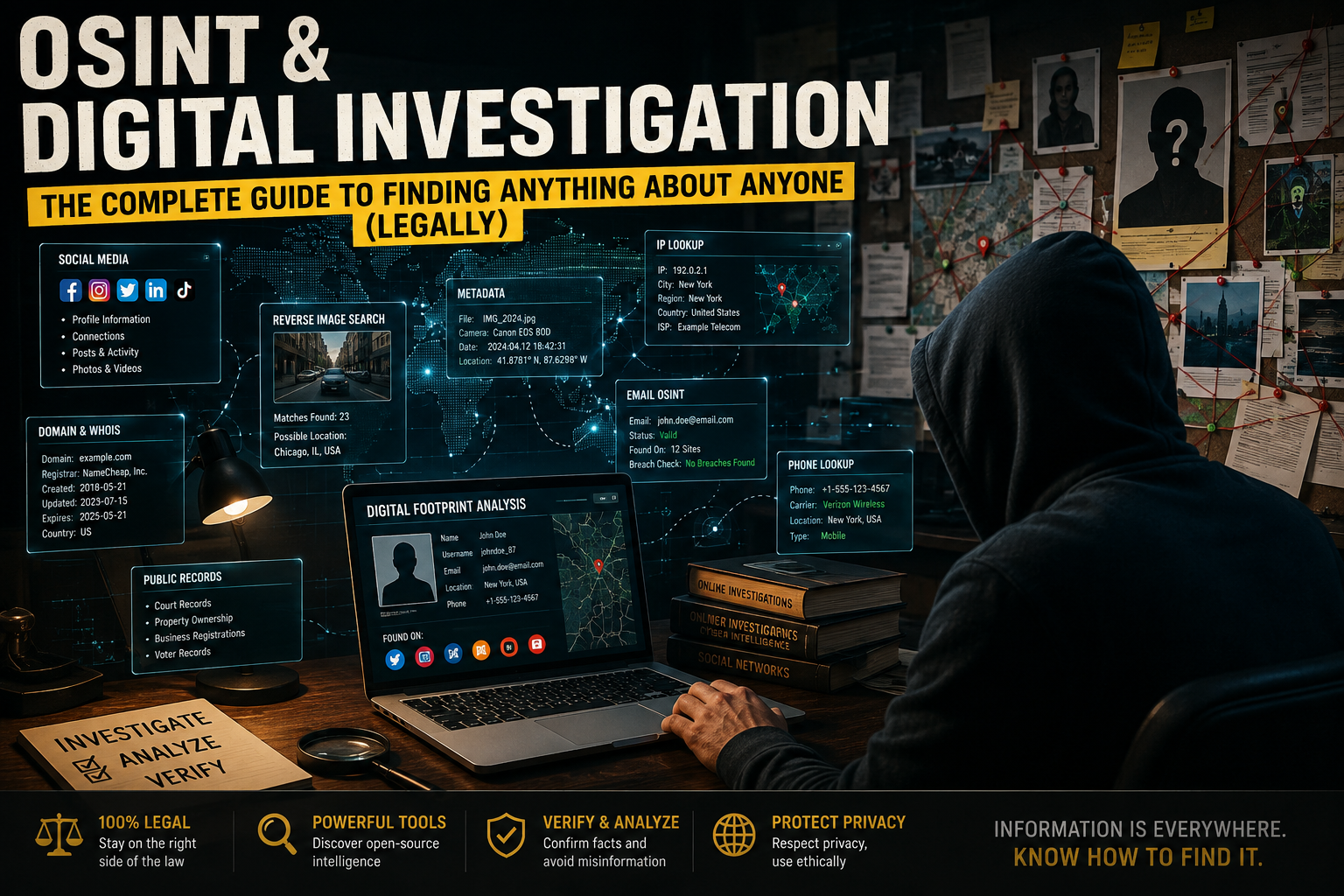
That includes:
- Social media posts, photos, and metadata
- Public records (property, court, business filings)
- Domain and website registration data
- Forum posts, comments, and old usernames
- Satellite and street-level imagery
- Leaked data that’s already circulating publicly (not accessed illegally)
- Archived versions of deleted content
The core principle: if it’s out there and you didn’t need to break a law or a password to see it, it’s fair game for OSINT.
Why This Skill Is Exploding Right Now
A few years ago, OSINT was a niche term known mostly to intelligence analysts and hardcore hobbyists on forums like Bellingcat’s community. That’s changed fast, for a few reasons:
- Scam culture forced people to learn self-defense. Romance scams, fake job offers, and rental fraud have made “can I verify this person is real” a daily concern for millions.
- Journalism went open-source. Major investigations — from war crime verification to corporate fraud exposés — are now built almost entirely on OSINT techniques, not leaked documents.
- Employers screen differently now. Background checks increasingly include digital footprint analysis, not just criminal records.
- Everyone overshares. The average person’s digital footprint today is exponentially larger than it was a decade ago, and most of it is searchable.
The Investigator’s Mindset: Start Wide, Then Narrow
Professional investigators don’t start by guessing usernames or stalking a Facebook profile. They follow a funnel:
Step 1 — Establish an anchor. This is one confirmed, unique piece of data: a full name, an email, a phone number, or a username. Everything else builds from here.
Step 2 — Pivot across platforms. The same email or username often gets reused across dozens of sites, even ones the person forgot they signed up for a decade ago.
Step 3 — Cross-verify, don’t assume. Two accounts with the same name aren’t automatically the same person. Real OSINT work is about confirming overlap — same photo, same writing style, same linked account — not coincidence.
Step 4 — Build a timeline. Dates matter. When did an account appear? When did it go quiet? A gap in activity often tells you more than the content itself.
Tools That Actually Matter (Not the Generic List)
Most articles just dump a list of fifteen tools with one-line descriptions. Here’s what actually separates casual searching from real investigative work:
Username & Identity Pivoting
Tools like Sherlock, Maigret, and WhatsMyName scan hundreds of platforms simultaneously for a given username. But the trick most people miss: run variations. Add underscores, swap letters for numbers, try the handle with and without a birth year. People are creatures of habit — they reuse patterns, not just exact strings.
Reverse Image Search, Done Right
Everyone knows Google Images and TinEye. Fewer people know that Yandex consistently outperforms both for facial matching, especially with non-Western faces and older photos, because of how its indexing model was trained. If you’re only using Google, you’re missing a huge chunk of matches.
Metadata Extraction
Photos carry hidden data — GPS coordinates, device model, timestamps — unless it’s been stripped. Tools like ExifTool pull this instantly. This single technique has cracked more location-based investigations than almost any other method, because most people never think to scrub their images before posting.
Archived & Deleted Content
The Wayback Machine is well known, but cache viewers, Google’s cached pages, and lesser-known archive crawlers like Archive.today often preserve content that Wayback missed — especially social media posts and forum threads that get deleted within hours.
Domain & Infrastructure Research
For investigating businesses or suspicious websites: WHOIS lookups, DNS history tools, and SSL certificate transparency logs (like crt.sh) reveal ownership trails that a simple “who owns this site” search won’t show. Certificate logs in particular are underused — they quietly expose every subdomain a company has ever spun up, including ones meant to stay hidden.
The Techniques Almost Nobody Talks About
This is the part most OSINT content skips entirely — the tricks that separate hobbyists from people who do this professionally.
1. Shadow accounts reveal more than main accounts. People are careless on secondary or “throwaway” profiles because they don’t think anyone’s watching. Cross-referencing a main account’s followers/following list often surfaces these secondary accounts.
2. Group photos are goldmines. A person might lock down their own profile completely — but they can’t control what a friend tags them in. Searching tagged photos and mutual connections frequently reveals more than the target’s own account ever would.
3. Writing style is a fingerprint. Stylometry — analyzing sentence structure, punctuation habits, and word choice — can link anonymous accounts to known identities even when every other identifier has been scrubbed. It’s how several high-profile anonymous accounts have been unmasked over the years.
4. Check the “liked” content, not just the posts. People curate what they post far more carefully than what they like, comment on, or follow. Engagement history often reveals interests, locations, and relationships a profile itself hides.
5. Old email addresses never really die. Search an old, “abandoned” email through breach-checking services and people-search aggregators — it often resurfaces years later, linked to new accounts the person created without realizing the old address was still traceable.
The Legal and Ethical Line You Cannot Cross
This is the part that responsible content has to be upfront about, because OSINT sits in a legally gray zone that varies by country and intent.
Generally legal: Looking up publicly available information for journalism, due diligence, personal safety verification, hiring checks (within legal limits), or academic research.
Generally illegal or unethical, regardless of intent:
- Accessing accounts or data behind a login you don’t own
- Using information to harass, stalk, or intimidate (this is a crime in most countries, often called cyberstalking)
- Buying data from breach markets or paying for illegally obtained records
- Impersonating someone to trick platforms into revealing private data (pretexting)
- Compiling and publishing someone’s home address, workplace, and daily routine together — even from public sources — can constitute doxxing and is illegal in many jurisdictions even if each individual fact was public
The rule professionals live by: public availability does not equal permission to weaponize. Just because you can find something doesn’t mean using it is legal or ethical. Courts increasingly look at intent and aggregation — compiling scattered public facts into a targeted profile can itself be the crime, even when no single piece of data was private.
How to Protect Yourself From Being an OSINT Target
Since you now know how easy this is to do to someone, here’s how to make it harder for it to be done to you:
- Reverse-search your own name and old usernames periodically to see what’s still indexed
- Strip metadata from photos before posting — most phones have a setting for this
- Separate your professional and personal digital identities with different emails and handles
- Check what your “liked” and “tagged” content reveals — lock these down, not just your main posts
- Search your old email addresses in breach-checking services to see what’s linked to them
- Reduce location tagging, especially real-time posts, since patterns reveal your routine faster than a single post
Frequently Asked Questions
Is OSINT the same as hacking? No. Hacking involves unauthorized access to systems or data. OSINT strictly uses publicly available information. If you need a password, an exploit, or unauthorized access to get it, it’s not OSINT anymore.
Do I need to be a cybersecurity expert to learn OSINT? Not at all. The core skills are pattern recognition, patience, and knowing where to search. Many of the best OSINT practitioners come from journalism, law, or investigative backgrounds rather than tech.
Can companies legally use OSINT to screen job applicants? In most places, yes — with limits. Employers generally can’t factor in protected characteristics (like religion, health, or ethnicity) even if discovered through public information, and several regions require disclosure that a background check occurred.
What’s the best way to start learning OSINT? Practice on yourself first. Try to reconstruct your own digital footprint from scratch using only public tools. It’s legal, it’s safe, and it teaches you exactly how exposed the average person actually is — including you.
The Bigger Picture
OSINT isn’t just a toolkit — it’s a mindset shift. Once you understand how much of the internet is quietly, permanently public, you start seeing the web differently. Every post, tag, comment, and forgotten account becomes a data point in a trail that doesn’t erase itself just because you stopped thinking about it.
Used responsibly, it’s one of the most powerful tools for accountability, safety, and truth-finding that exists today. Used irresponsibly, it becomes exactly the kind of surveillance most people are trying to protect themselves from.
The line between the two isn’t the technique. It’s the intent behind it.
Learn how OSINT investigations work, from finding public information to verifying identities, tracking digital footprints, using OSINT tools, and staying within legal and ethical limits.
Discover the real OSINT workflow, useful investigation tools, identity-pivoting techniques, digital footprints, verification methods, and the legal limits investigators need to understand.