




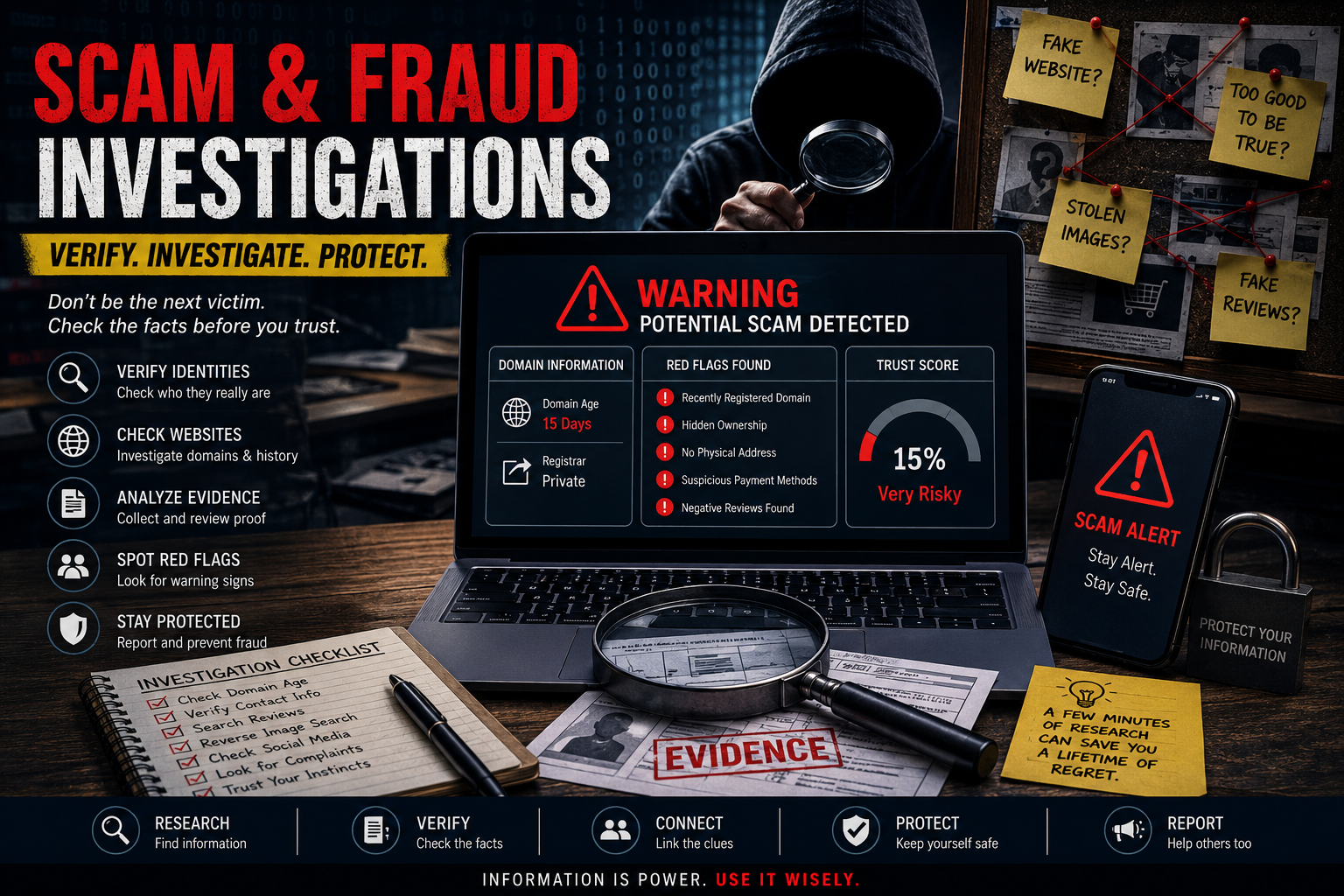
Scams have changed dramatically. A suspicious phone call is no longer the only warning sign. Today, fraud can arrive through a social media message, online marketplace, fake job advertisement, investment website, email, text message, or even a convincing website that looks completely legitimate.
The difficult part is that modern scams are often designed to look ordinary.
Discover practical ways to investigate suspicious websites, businesses, job offers, investment platforms, social accounts, and online communications.
That is why scam and fraud investigation is not simply about spotting something that “looks suspicious.” It is about collecting information, checking independent evidence, identifying inconsistencies, and understanding how the pieces connect.
This guide explains how ordinary internet users can investigate suspicious websites, messages, accounts, businesses, job offers, and financial opportunities using publicly available information.
What Is a Scam & Fraud Investigation?
A scam investigation is the process of examining information connected to suspected fraud to determine:
- Who is behind the activity?
- Is the person, company, or website legitimate?
- When was the online presence created?
- Where does the information lead?
- Are different accounts connected?
- Has the same identity appeared elsewhere?
- Do public records support the claims being made?
- Are there warning signs that suggest deception?
Professional investigators may have access to specialized databases and legal investigative tools.
However, ordinary users can still perform useful open-source research, often called OSINT (Open-Source Intelligence), using information that is publicly available.
The important distinction is that public information should be used to verify claims, not to harass, expose, or wrongly accuse individuals.
Why Scam Investigation Matters
Many people investigate a scam only after losing money.
That is often too late.
A few minutes of verification before sending money, sharing personal information, purchasing an expensive product, or accepting a job offer can sometimes reveal major warning signs.
For example, a suspicious website might claim:
“Operating since 2018.”
But its domain may have been registered only recently.
That does not automatically prove fraud. A legitimate company can launch a new website or change domains. But it creates a question worth investigating.
The goal is to build a pattern of evidence, not jump to a conclusion from one clue
Common Types of Scams Worth Investigating
Different scams leave different types of evidence.
Online Shopping Scams
Fake stores may advertise electronics, clothing, luxury products, tickets, or other goods at unusually attractive prices.
Warning signs can include:
- Recently created website
- Missing company information
- Copied product descriptions
- Unrealistic discounts
- Poorly written policies
- Suspicious payment methods
- No verifiable physical presence
- Reviews that appear manufactured
- Contact information that does not work
A professional-looking website does not automatically mean the business is legitimate.
Job and Employment Scams
Fake job offers often exploit people who are urgently looking for employment.
Be cautious when someone:
- Offers unusually high pay for very little work
- Requests money before hiring
- Asks you to purchase equipment from a specific seller
- Requests sensitive identity documents too early
- Uses a free email account while claiming to represent a major corporation
- Sends a check and asks you to return part of the money
- Pressures you to act immediately
A genuine company should be independently verifiable.
Do not rely exclusively on the contact information supplied by the recruiter.
Investment Scams
Investment fraud can be particularly convincing because scammers often create professional dashboards showing profits.
A website may display:
- Account balances
- Trading charts
- Profit percentages
- Customer testimonials
- “Financial experts”
- Regulatory claims
None of these elements, by themselves, prove that the investment is legitimate.
A critical question is:
Can the company and the people behind it be independently verified through authoritative sources?
If someone promises guaranteed high returns with little or no risk, treat the claim as a major warning sign.
Cryptocurrency Scams
Crypto scams can involve fake exchanges, fraudulent investment platforms, impersonation, giveaway schemes, fake mining operations, and social-engineering attacks.
Investigating them may involve examining:
- Domain registration information
- Company claims
- Public regulatory information
- Wallet addresses
- Transaction history
- Social media accounts
- Website history
- Independent reporting
A cryptocurrency transaction can be difficult or impossible to reverse, so verification before sending funds is particularly important.
Start With the Claim, Not the Person
One of the most important investigation principles is to start with a claim that can be tested.
Suppose a website says:
“We have been serving customers for 15 years.”
Do not begin by trying to identify the owner.
First ask:
What evidence should exist if this claim is true?
You might expect:
- An older web presence
- Historical references
- Business registrations
- Archived pages
- Long-standing social accounts
- Customer discussions
- Independent mentions
Then compare the claim against available evidence.
This approach is more reliable than beginning with a suspicion and searching only for information that confirms it.
Step 1: Save the Evidence
Before contacting the suspected scammer, preserve what you already have.
Save:
- Website address
- Screenshots
- Emails
- Text messages
- Usernames
- Profile URLs
- Phone numbers
- Email addresses
- Payment instructions
- Transaction information
- Advertisements
- Invoices
- Receipts
- Cryptocurrency wallet addresses
- Dates and times
Why save everything?
Because online information can change or disappear.
A website may be redesigned. A social-media account may be deleted. A scammer may change a username.
A screenshot showing what you saw at a particular time can become valuable evidence.
Step 2: Investigate the Website
If the suspected scam involves a website, start with the domain.
Look for:
- Domain age
- Registration information
- Company name
- Physical address
- Contact details
- Privacy policy
- Terms and conditions
- Refund policy
- Business registration claims
- Social media links
Domain age is a clue, not proof
A new domain does not automatically mean a scam.
Legitimate businesses launch new websites every day.
But consider the combination:
New domain + huge discounts + copied content + anonymous ownership + pressure to pay = much stronger concern.
Good investigations look at multiple independent indicators.
Step 3: Search the Company’s Name
Search the business name independently rather than using links supplied by the company.
Look for:
- Official business registrations
- News coverage
- Consumer complaints
- Industry directories
- Regulatory information
- Customer discussions
- Professional profiles
- Previous websites
Pay attention to inconsistencies.
For example:
Website: Claims headquarters in London
Business record: Lists a different jurisdiction
Contact number: Associated with another country
Social account: Claims a different founding date
One inconsistency may have an innocent explanation.
Several unrelated inconsistencies deserve closer examination.
Step 4: Reverse-Search Images
Scammers frequently reuse photographs from legitimate companies, stock websites, influencers, or unrelated businesses.
A reverse-image search can help determine whether an image appears elsewhere online.
Useful targets include:
- Company logos
- Product photographs
- Employee photographs
- Office photographs
- Profile pictures
- Property images
Example
Imagine a supposed property-rental company uses a photograph of an apartment.
A reverse search reveals that the same photograph appeared years earlier on a completely unrelated real-estate website in another country.
That does not prove the rental company is fraudulent by itself, but it raises a serious question about the advertisement.
Step 5: Examine Social Media Accounts
Social media can provide useful investigative clues.
Look at:
- Account creation history when publicly available
- Username changes
- Posting patterns
- Followers and engagement
- Reused photographs
- Claimed location
- External links
- Contact information
- Connections between accounts
Be careful with follower counts.
A large number of followers does not necessarily indicate legitimacy.
Likewise, a small account is not automatically fraudulent.
Look for consistency over time.
A legitimate organization generally leaves a coherent public footprint rather than appearing suddenly with dozens of contradictory claims.
Step 6: Check Email Addresses
The email address itself can provide useful context.
For example:
Claim: “I represent a major company.”
Email: Uses a completely unrelated free email service.
That deserves verification.
However, free email addresses are not proof of fraud. Small businesses, contractors, freelancers, and legitimate recruiters sometimes use them.
The important question is whether the email identity matches the organization being claimed.
Look carefully for deceptive spellings.
For example:
company-support.com
may look legitimate at first glance while the real organization uses:
company.com
Scammers sometimes register domains designed to resemble genuine businesses.
Step 7: Investigate Phone Numbers
A phone number can sometimes connect seemingly unrelated pieces of information.
Search the number in quotation marks and compare results.
You may discover:
- Business listings
- Scam reports
- Public advertisements
- Multiple claimed identities
- Different businesses using the same number
Again, one search result should not be treated as conclusive evidence.
Phone numbers can be reassigned, shared, spoofed, or legitimately used by different services.
Treat them as investigative leads.
Step 8: Look for Copy-Pasted Content
One surprisingly useful technique is searching distinctive phrases.
Take an unusual sentence from the website and search for it.
If identical wording appears across multiple unrelated websites, investigate further.
This can reveal:
- Template websites
- Copied company descriptions
- Fake testimonials
- Reused refund policies
- Duplicate job advertisements
- Networks of related sites
Scammers sometimes change company names while leaving much of the underlying text untouched.
Step 9: Examine Reviews Carefully
Reviews can be useful—but they should never be your only evidence.
Look for patterns rather than individual comments.
Potential warning signs include:
- Hundreds of reviews appearing within a short period
- Repeated wording
- Generic praise with no specific details
- Reviews that mention products the company does not appear to sell
- Similar profiles posting across unrelated businesses
- A dramatic difference between independent review platforms
A single negative review does not prove fraud.
Likewise, hundreds of positive reviews do not guarantee legitimacy.
Step 10: Check the Company’s Physical Address
A listed address should be independently verified.
Search the address separately.
Ask:
- Does the business actually appear there?
- Is it an office building?
- Is it a residential property?
- Does another company occupy the location?
- Does the location match the company’s claimed industry?
Virtual offices are not automatically suspicious.
Many legitimate businesses use them.
The issue arises when a company makes claims about a physical operation that cannot be independently supported.
Step 11: Build a Timeline
A timeline can reveal contradictions that are difficult to notice when information is viewed separately.
Create a simple sequence:
January: Domain registered
February: Social-media account created
March: Company claims five years of operation
April: First customer complaints appear
The timeline does not automatically prove wrongdoing.
But it gives you a structured way to compare claims against observable events.
Step 12: Connect the Evidence
The strongest investigations rarely depend on one discovery.
Instead, multiple pieces of information reinforce each other.
For example:
| Finding | What it tells you |
|---|---|
| Recently created domain | Online presence may be new |
| Copied product images | Marketing material may not be original |
| Different company address | Business identity needs verification |
| Unrelated payment account | Payment identity may not match company |
| Fake-looking reviews | Reputation may be manipulated |
| Pressure to pay immediately | Potential social-engineering tactic |
Individually, these findings may have innocent explanations.
Together, they can create a much stronger basis for caution.
Avoid Confirmation Bias
This is one of the biggest dangers in amateur investigations.
If you decide someone is a scammer before investigating, you may unconsciously search only for evidence that supports your conclusion.
Instead, ask two questions:
What evidence suggests this may be fraudulent?
And:
What evidence suggests it may be legitimate?
The second question is just as important.
Good investigation requires the willingness to change your conclusion when new evidence appears.
Scam Warning Signs That Deserve Attention
No single warning sign proves fraud, but combinations can be significant.
Financial pressure
“Pay within 30 minutes.”
“Your account will be closed today.”
“Send the money before the offer expires.”
Urgency can prevent people from taking time to verify information.
Unusually attractive offers
Huge profits, extremely cheap products, guaranteed employment, or unrealistic discounts deserve additional scrutiny.
Requests for unusual payment methods
Be cautious when someone insists on payment methods that offer little protection or are difficult to reverse.
Identity inconsistencies
Names, addresses, company information, phone numbers, and email domains should make sense together.
Refusal to provide verifiable information
A legitimate organization should generally be able to provide basic information that can be independently checked.
What Not to Do During an Investigation
Investigating a suspected scam does not give someone permission to invade another person’s privacy.
Do not:
- Hack accounts
- Guess passwords
- Break into private systems
- Threaten suspected scammers
- Publish private personal information
- Impersonate law enforcement
- Attempt unauthorized access
- Harass relatives or associates
- Make accusations without sufficient evidence
Stay within lawful and ethical boundaries.
The purpose of investigation should be verification, protection, documentation, and reporting.
How to Create a Strong Evidence File
If you are documenting a suspected scam, organize the information instead of keeping random screenshots.
Create sections for:
Identity
- Name used
- Username
- Phone number
- Claimed organization
Website
- Domain
- Important pages
- Registration information
- Contact details
Communications
- Emails
- Messages
- Dates
- Promises or claims
Financial information
- Payment instructions
- Account details
- Transaction IDs
- Wallet addresses
Supporting evidence
- Screenshots
- Archived pages
- Reverse-image findings
- Independent records
- Relevant public reports
Timeline
Record important events in chronological order.
This makes the information much easier to understand and report.
How to Tell a Scam From a Legitimate Business
The goal is not to find a business with zero negative information.
Almost every real company eventually receives complaints.
Instead, examine the overall picture.
A legitimate organization is more likely to have:
- Consistent business information
- A traceable history
- Verifiable contact details
- Consistent branding
- Independent references
- Clear policies
- Reasonable payment practices
- A coherent online presence
A suspicious operation may show:
- Contradictory information
- Sudden online activity
- Fake or copied content
- Anonymous ownership
- Pressure tactics
- Unverifiable claims
- Multiple unrelated identities
- Difficult-to-reverse payment requests
The difference is usually found in the pattern, not one isolated clue.
What to Do If You Think You Have Been Scammed
Act quickly.
First, stop communicating if necessary
Do not send additional money simply because someone claims another payment is required to recover your funds.
Contact your financial provider
If money was transferred, contact your bank, card issuer, payment provider, or relevant financial institution as soon as possible.
Explain what happened and ask what recovery or dispute options are available.
Change compromised passwords
If you shared login information, change the affected password immediately.
If you reused that password elsewhere, change those accounts too.
Enable multi-factor authentication
Where available, use MFA to add another layer of protection.
Preserve evidence
Keep messages, receipts, transaction records, account details, screenshots, and website information.
Report the incident
Use the appropriate platform, financial institution, consumer-protection agency, law-enforcement channel, or cybercrime reporting mechanism available in your country.
A Simple Scam Investigation Workflow
When you encounter something suspicious, follow this sequence:
1. Stop
Do not send money or sensitive information immediately.
2. Capture
Save the website, messages, advertisements, usernames, and other relevant evidence.
3. Verify
Check the company, person, website, domain, address, phone number, and claims independently.
4. Compare
Look for inconsistencies across different sources.
5. Investigate
Use public information such as historical pages, business records, reverse-image searches, and independent reporting.
6. Document
Organize findings into a timeline.
7. Decide
Determine whether the available evidence supports caution, legitimacy, or further investigation.
8. Report
If appropriate, report suspected fraud through legitimate channels.
The Most Important Rule: Don’t Rush
Scammers benefit from urgency.
A person who has time to think is much harder to manipulate than someone who believes they must act immediately.
Before sending money, ask:
Who am I paying?
Why am I paying?
Can I independently verify the person or organization?
What happens if the transaction goes wrong?
Am I being pressured to ignore normal verification steps?
If you cannot answer these questions comfortably, pause the transaction.
Final Thoughts
Scam and fraud investigations are not about becoming an internet detective overnight.
They are about developing a habit of verification.
A website can look professional and still be deceptive. A social-media account can have thousands of followers and still be fraudulent. A company can have a real address and still make false claims.
That is why reliable investigation combines multiple sources.
Check the claim. Examine the history. Compare identities. Search for copied material. Verify the business independently. Preserve evidence. Look for patterns.
And most importantly, do not confuse suspicion with proof.
The strongest investigation is one that can explain not only why something looks suspicious, but also what evidence supports that conclusion.
Frequently Asked Questions
What is OSINT in scam investigation?
OSINT stands for Open-Source Intelligence. It involves collecting and analyzing information that is legally and publicly available, such as websites, public records, social-media information, news reports, domain information, and other open sources.
Can a new website be a scam?
Yes, but a new domain alone does not prove fraud. New businesses legitimately create websites every day. Domain age becomes more meaningful when combined with other warning signs.
Can I investigate a scammer using their phone number?
A phone number can sometimes provide useful public information, but search results are not automatically proof of identity. Numbers can be spoofed, reassigned, or shared.
Are fake reviews a sign of fraud?
They can be a warning sign, particularly when combined with other inconsistencies. However, unusual reviews alone are not enough to establish that a business is fraudulent.
Can reverse-image searches expose scams?
They can sometimes reveal that product photographs, profile pictures, property images, or other material were copied from unrelated websites. This can provide a valuable investigative lead.
Should I confront someone I believe is a scammer?
Usually, no. Confrontation can cause the person to delete evidence, change accounts, or increase pressure on the victim. Preserving evidence and reporting the activity through appropriate channels is generally safer.
What is the strongest evidence of a scam?
There is no universal single piece of evidence. Strong cases usually involve several independent findings that contradict the person’s claims or demonstrate deceptive behavior.
Can I investigate someone without hacking them?
Yes. Much useful investigation can be conducted using lawful, publicly available information. You should never access private accounts, bypass security, or obtain information through unauthorized means.