








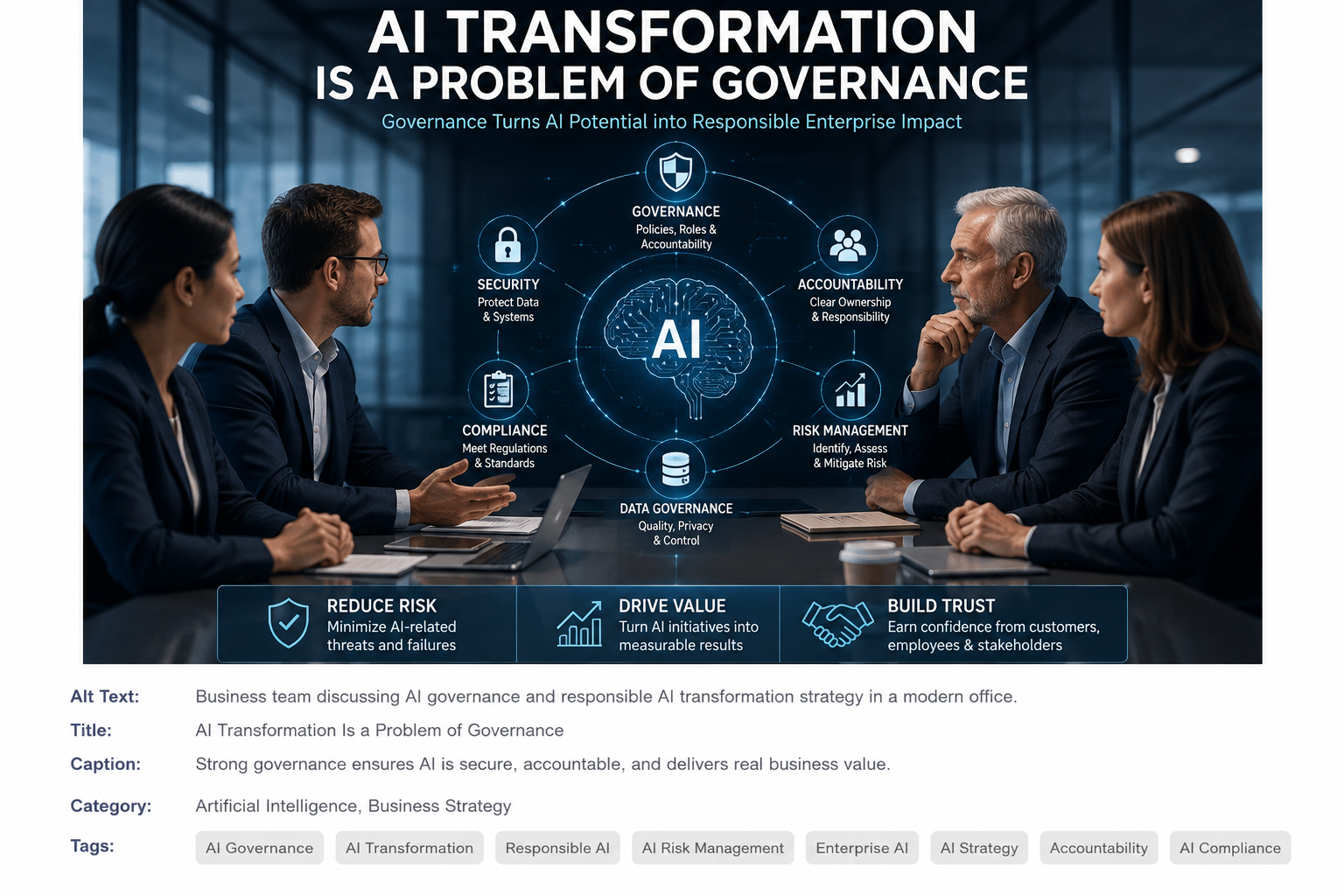
Artificial intelligence is no longer just an experimental technology sitting inside an innovation lab. Organizations are putting AI into customer service, software development, marketing, finance, cybersecurity, legal work, operations, research, and increasingly autonomous workflows.
That creates a problem that is easy to underestimate.
The hardest question is often no longer “Can we use AI?”
It is:
“Who is responsible for what happens when we use AI at scale?”
That is why AI transformation is increasingly a problem of governance.
AI governance is not simply about creating a policy document or asking employees which AI tools they are allowed to use. At enterprise scale, governance determines who can deploy AI, which systems can access sensitive information, what decisions AI can make, when humans must intervene, how models are monitored, how incidents are handled, and who remains accountable for the outcome.
The technology may enable transformation. Governance determines whether that transformation can be scaled without losing control.
What Does “AI Transformation Is a Problem of Governance” Mean?
AI transformation means more than adding an AI chatbot to an existing workflow.
True transformation changes how an organization operates.
AI can alter:
- how employees perform their jobs
- how decisions are made
- how customers interact with a company
- how information moves through the organization
- how software is developed
- how risks are identified
- how work is allocated between humans and machines
- how products and services are created
Once AI begins affecting these areas, traditional technology governance becomes insufficient.
Consider a simple example.
A company initially allows employees to use an AI assistant to summarize documents. Governance may appear straightforward.
Then the organization connects AI to internal databases.
Next, AI begins drafting customer responses.
Then an AI agent can update records.
Eventually, an agent can trigger actions without asking a human every time.
The organization has moved from using an AI tool to delegating parts of its operating model to AI.
That is a governance problem.
AI Adoption Is Not the Same as AI Transformation
One of the biggest mistakes organizations make is treating AI adoption and AI transformation as the same thing.
AI adoption
AI adoption usually means introducing AI into existing activities.
Examples include:
- using generative AI for writing
- summarizing meetings
- creating code
- analyzing documents
- generating marketing ideas
- assisting customer support
AI transformation
AI transformation goes considerably further.
It may involve:
- redesigning workflows
- changing organizational structures
- automating decisions
- deploying AI agents
- changing employee responsibilities
- connecting AI to business-critical systems
- redesigning products
- changing customer experiences
- creating new operating models
The governance requirements therefore increase as AI moves closer to consequential decisions and autonomous action.
A useful way to think about the progression is:
AI Experimentation
       ↓
AI Adoption
       ↓
AI Integration
       ↓
AI Automation
       ↓
AI Agents & Autonomous Actions
       ↓
Enterprise AI Transformation
       ↓
Greater Governance Requirement
The more authority AI receives, the more important governance becomes.
Why AI Transformation Creates a Governance Problem
AI introduces several characteristics that traditional software systems do not always have in the same way.
AI systems can produce probabilistic outputs, adapt to changing inputs, interact with users in natural language, rely on complex data pipelines, and increasingly connect with other systems.
Agentic AI adds another layer of complexity because systems may be able to plan, call tools, interact with applications, and perform multi-step tasks.
This creates several governance questions.
Who owns the AI system?
An organization may have an IT team operating the infrastructure, a business team owning the workflow, a security team managing risks, and an external vendor supplying the model.
Who is ultimately accountable?
Without clear ownership, responsibility can become fragmented.
What is AI allowed to do?
An AI assistant that recommends an action is fundamentally different from an AI system that executes it.
Organizations need clearly defined authority boundaries.
For example:
AI may recommend
       ↓
Human reviews
       ↓
Human approves
       ↓
AI executes
For higher-risk applications, the organization may instead require:
AI generates recommendation
       ↓
Automated risk check
       ↓
Human decision
       ↓
Authorized execution
       ↓
Continuous monitoring
The exact model should depend on the consequences of failure.
What happens when AI is wrong?
AI systems can produce incorrect, incomplete, biased, or inappropriate outputs.
The important governance question is not simply whether AI can make mistakes.
Every complex system can fail.
The question is:
What happens when it does?
A mature organization should know how an AI incident is detected, reported, investigated, contained, corrected, and documented.
The 7 Core Problems Organizations Must Govern
1. Accountability
Someone must ultimately be responsible for an AI-enabled process.
“An algorithm made the decision” is not an adequate accountability model.
Organizations should define ownership across the AI lifecycle, including:
- development
- procurement
- deployment
- monitoring
- risk management
- incident response
- retirement
2. Data Governance
AI transformation is heavily dependent on data.
Poor data governance can create problems involving:
- privacy
- accuracy
- security
- access
- data provenance
- retention
- intellectual property
- sensitive information
An impressive model cannot compensate for uncontrolled data.
3. Security
AI expands the attack surface of an organization.
Depending on the architecture, risks can involve:
- unauthorized access
- prompt injection
- sensitive-data exposure
- compromised integrations
- malicious inputs
- insecure AI agents
- excessive permissions
- model or supply-chain vulnerabilities
AI governance therefore needs to connect with existing cybersecurity governance rather than operating as an isolated department.
4. Human Oversight
Not every AI decision requires the same level of human involvement.
A low-risk recommendation might need minimal intervention.
A decision affecting employment, finances, safety, healthcare, legal rights, or access to important services may require substantially stronger oversight.
A useful governance principle is:
The greater the potential consequence of an AI error, the stronger the required controls should be.
5. Compliance and Policy
AI systems can interact with privacy, employment, consumer protection, financial, sector-specific, and other regulatory requirements.
The exact obligations vary by jurisdiction and use case.
For organizations operating across the United States, this makes governance more complicated because federal, state, industry, contractual, and organizational requirements may overlap.
Governance should therefore translate legal and policy requirements into operational controls rather than leaving them as abstract rules.
6. Model and Vendor Risk
Organizations increasingly depend on external AI providers.
That creates questions such as:
- Where is data processed?
- What happens to submitted information?
- How is access controlled?
- What happens when the vendor changes its model?
- How are incidents reported?
- What happens if the service becomes unavailable?
- Can the organization audit important controls?
- What happens when a model behaves differently after an update?
Vendor governance becomes especially important when AI is integrated into critical business processes.
7. Monitoring and Incident Response
Governance cannot end at deployment.
An AI system that performed correctly during testing may behave differently after:
- a model update
- a data change
- a workflow change
- a new integration
- a change in user behavior
- increased scale
Organizations therefore need continuous monitoring.
Why AI Agents Make Governance More Difficult
Generative AI creates governance challenges.
AI agents can make them considerably more complicated.
A conventional AI assistant may answer a question.
An agent may:
- interpret a goal
- create a plan
- access information
- call external tools
- modify data
- communicate with another system
- continue working through multiple steps
That changes the governance question from:
“Is this answer accurate?”
to:
“What is this system authorized to do?”
This distinction is critical.
An organization deploying AI agents should define:
- permitted actions
- prohibited actions
- available tools
- data access
- spending limits
- authentication requirements
- escalation rules
- human approval requirements
- logging requirements
- shutdown mechanisms
Current enterprise research is increasingly highlighting agentic AI governance as a distinct capability rather than simply an extension of conventional AI policy.
What Effective AI Governance Should Look Like
Effective governance should not become a bureaucratic obstacle that prevents every AI experiment.
The better approach is risk-based governance.
Low-risk applications should generally face lighter controls.
High-risk applications should face stronger controls.
A simplified model looks like this:
| AI Use | Typical Risk | Governance Approach |
|---|---|---|
| Brainstorming | Low | Basic acceptable-use rules |
| Internal summarization | Low–Moderate | Data and privacy controls |
| Customer communications | Moderate | Review and monitoring |
| Financial recommendations | High | Strong controls and oversight |
| Autonomous business actions | High | Authorization and monitoring |
| Safety-critical decisions | Very High | Rigorous testing and human oversight |
The exact classification should be determined by the organization’s industry, use case, jurisdiction, and risk tolerance.
A Practical AI Governance Framework
A practical governance system can be organized into eight stages.
1. INVENTORY
      ↓
Identify AI systems and use cases
      ↓
2. CLASSIFY
      ↓
Determine risk and business impact
      ↓
3. ASSIGN OWNERSHIP
      ↓
Define accountable people and teams
      ↓
4. CONTROL
      ↓
Set permissions, policies and safeguards
      ↓
5. TEST
      ↓
Evaluate performance, security and risks
      ↓
6. DEPLOY
      ↓
Release according to approved controls
      ↓
7. MONITOR
      ↓
Track behavior, incidents and outcomes
      ↓
8. IMPROVE OR RETIRE
      ↓
Update, restrict, replace or shut down systems
This is fundamentally different from writing an AI policy and considering the job finished.
Governance should become an operational capability.
Who Should Be Responsible for AI Decisions?
There is no universal organizational structure that works for every company.
However, responsibility should be explicit.
Depending on the organization, relevant roles may include:
- board of directors
- executive leadership
- CIO
- CTO
- Chief AI Officer
- Chief Information Security Officer
- legal and compliance teams
- data leadership
- business-unit leaders
- risk management
- internal audit
- AI governance committees
The important principle is not which job title owns AI.
It is whether ownership is clear.
A strong governance model answers:
Who can approve an AI system?
Who owns the business outcome?
Who monitors the risk?
Who can stop the system?
Who investigates incidents?
Who approves changes?
If an organization cannot answer those questions, its AI transformation may be moving faster than its governance.
How to Govern AI Without Killing Innovation
One of the strongest arguments against excessive AI governance is that complicated approval processes can slow experimentation.
That concern is legitimate.
Bad governance can become a bottleneck.
Good governance should do the opposite.
It should make safe experimentation easier by establishing clear boundaries.
For example:
Green zone
Employees can experiment with approved low-risk tools and non-sensitive information.
Yellow zone
Use requires additional review because the system handles internal information or affects customers.
Red zone
The application requires formal risk assessment, security review, legal/compliance evaluation, and executive approval.
This creates a guardrail model instead of a permission-for-everything model.
The objective is not:
Stop people from using AI.
The objective is:
Make it clear where AI can move quickly and where additional controls are necessary.
Common AI Governance Mistakes
Treating governance as an IT problem
AI affects strategy, finance, operations, workforce design, legal risk, security, and customer relationships.
It cannot be owned effectively by technology teams alone.
Creating a policy nobody follows
A 50-page policy is not useful if employees cannot understand how it applies to their daily work.
Governance must translate policy into practical decisions.
Allowing uncontrolled AI tools
Employees may adopt AI applications independently when official systems are difficult to use.
This can create shadow AI, where the organization does not know which tools are processing company information.
Focusing only on model accuracy
Accuracy is important, but it is not the entire risk picture.
A highly accurate system can still create privacy, security, compliance, accountability, or operational problems.
Ignoring AI after deployment
Testing before launch is not enough.
AI governance must continue throughout the system lifecycle.
Giving AI excessive permissions
An AI agent should not automatically receive the same access as a human administrator.
Permissions should follow the principle of least privilege.
Measuring activity instead of outcomes
The number of AI tools deployed is not the same as transformation success.
Organizations should measure whether AI actually improves:
- productivity
- quality
- customer outcomes
- decision-making
- cost
- risk
- employee experience
- revenue
- operational resilience
How to Measure Whether AI Governance Is Working
Organizations should monitor both risk and value.
Useful governance metrics can include:
- percentage of AI systems inventoried
- percentage with assigned owners
- percentage risk-assessed
- number of unresolved AI incidents
- time to detect AI-related incidents
- time to resolve incidents
- percentage of high-risk systems with human oversight
- percentage of AI vendors assessed
- policy violations
- security events
- model performance changes
- measurable business value
The goal is not to create an enormous dashboard.
The goal is to determine whether the organization knows what its AI systems are doing, whether they are producing value, and whether unacceptable risks are being controlled.
The U.S. AI Governance Landscape
For U.S. organizations, AI governance is developing alongside a rapidly changing policy environment.
NIST’s AI Risk Management Framework is an important voluntary U.S. reference for managing AI risks and incorporating trustworthiness considerations throughout the AI lifecycle.
Organizations should also monitor applicable federal requirements, state-level rules, industry-specific obligations, contractual requirements, and internal policies.
The important lesson is that compliance should not be treated as the entire governance strategy.
A company can comply with a particular requirement and still have weak operational governance.
Good governance connects:
Strategy + Risk + Security + Data + Compliance + People + Technology + Accountability
The U.S. policy environment is also continuing to evolve. Recent federal AI policy developments emphasize both technological competitiveness and responsible use, making ongoing monitoring particularly important for organizations operating in the United States.
AI Transformation Is Ultimately an Organizational Transformation
The biggest misconception about AI transformation is that it is primarily a technology implementation project.
It is not.
Technology is only one component.
AI transformation can change:
- organizational structures
- decision rights
- employee roles
- management processes
- customer relationships
- risk models
- data architecture
- operating costs
- competitive strategy
That is why governance belongs near the center of the transformation rather than at the end of it.
An organization should not first transform itself with AI and then ask how to control the consequences.
Governance should be designed alongside the transformation.
The Future: Governance Must Become Continuous
Traditional governance often works through periodic reviews.
AI is increasingly becoming continuous.
Models change.
Agents evolve.
Data changes.
Vendors update systems.
New use cases emerge.
Employees discover new applications.
Threats evolve.
That means AI governance needs to become more dynamic.
The future model is likely to look less like:
Policy → Approval → Deployment
and more like:
Policy
  ↓
Risk Classification
  ↓
Controls
  ↓
Deployment
  ↓
Continuous Monitoring
  ↓
Automated Alerts
  ↓
Human Escalation
  ↓
Reassessment
  ↓
Updated Controls
Governance becomes part of the AI operating system of the organization.
Final Takeaway
AI transformation is not ultimately limited by whether an organization can access powerful AI models.
The harder problem is whether the organization can use that power responsibly, repeatedly, securely, and at scale.
The companies that succeed will not necessarily be the companies with the most AI tools.
They will be the organizations that know:
- where AI should be used
- where it should not be used
- who owns each system
- what AI is allowed to do
- what data it can access
- when humans must intervene
- how risks are monitored
- how incidents are handled
- how business value is measured
That is why AI transformation is a problem of governance.
Governance is not the enemy of AI transformation.
Done properly, it is what makes transformation scalable.
Frequently Asked Questions
Is AI transformation really a governance problem?
Yes, particularly when AI moves beyond isolated experiments and becomes embedded in business processes, decision-making, data systems, and autonomous workflows. At that point, questions of ownership, permissions, accountability, risk, security, monitoring, and oversight become central to successful transformation.
What is AI governance?
AI governance is the collection of policies, roles, processes, controls, and oversight mechanisms used to ensure that AI systems are developed, deployed, and operated responsibly and according to organizational objectives and applicable requirements.
What is the difference between AI governance and AI transformation?
AI transformation describes how an organization changes its operations and business model through AI. AI governance provides the structures that determine how that transformation is controlled, monitored, and held accountable.
Why is AI agent governance important?
AI agents can potentially perform multi-step tasks and interact with business systems. That makes permissions, authorization, monitoring, human escalation, logging, and incident response particularly important.
Who should own AI governance?
There is no universal answer. Responsibility may involve executives, technology leadership, security, legal, compliance, risk, data teams, business leaders, and internal audit. What matters most is clearly defined accountability.
Does AI governance slow innovation?
Poor governance can. Well-designed governance can accelerate responsible innovation by creating clear risk boundaries, approved tools, standardized controls, and faster pathways for low-risk experimentation.
What is the NIST AI Risk Management Framework?
The NIST AI Risk Management Framework is a voluntary framework designed to help organizations manage risks associated with artificial intelligence and incorporate trustworthiness considerations into AI design, development, use, and evaluation.
How should companies govern AI agents?
Companies should establish clear authorization boundaries, least-privilege access, human escalation rules, monitoring, logging, testing, incident response, and lifecycle controls before allowing agents to perform consequential actions.
What is the biggest AI governance mistake?
One of the biggest mistakes is treating governance as a document rather than an operational capability. Policies only become useful when they translate into actual ownership, controls, monitoring, and decisions.
How can a company start building AI governance?
Start by creating an inventory of AI systems and use cases, assigning owners, classifying risks, identifying applicable requirements, establishing controls, and implementing continuous monitoring. Then improve the governance system as AI adoption expands.
AI transformation is a governance challenge. Learn how businesses manage AI risk, accountability, security, compliance, and responsible AI adoption.